


Full-Stack AI Agents in TypeScript (No Python Required)

course lessons.
1 Section · 5 LessonsCore Architecture & Production Implementation
- 1.1Why TypeScript Won the AI Application Layer
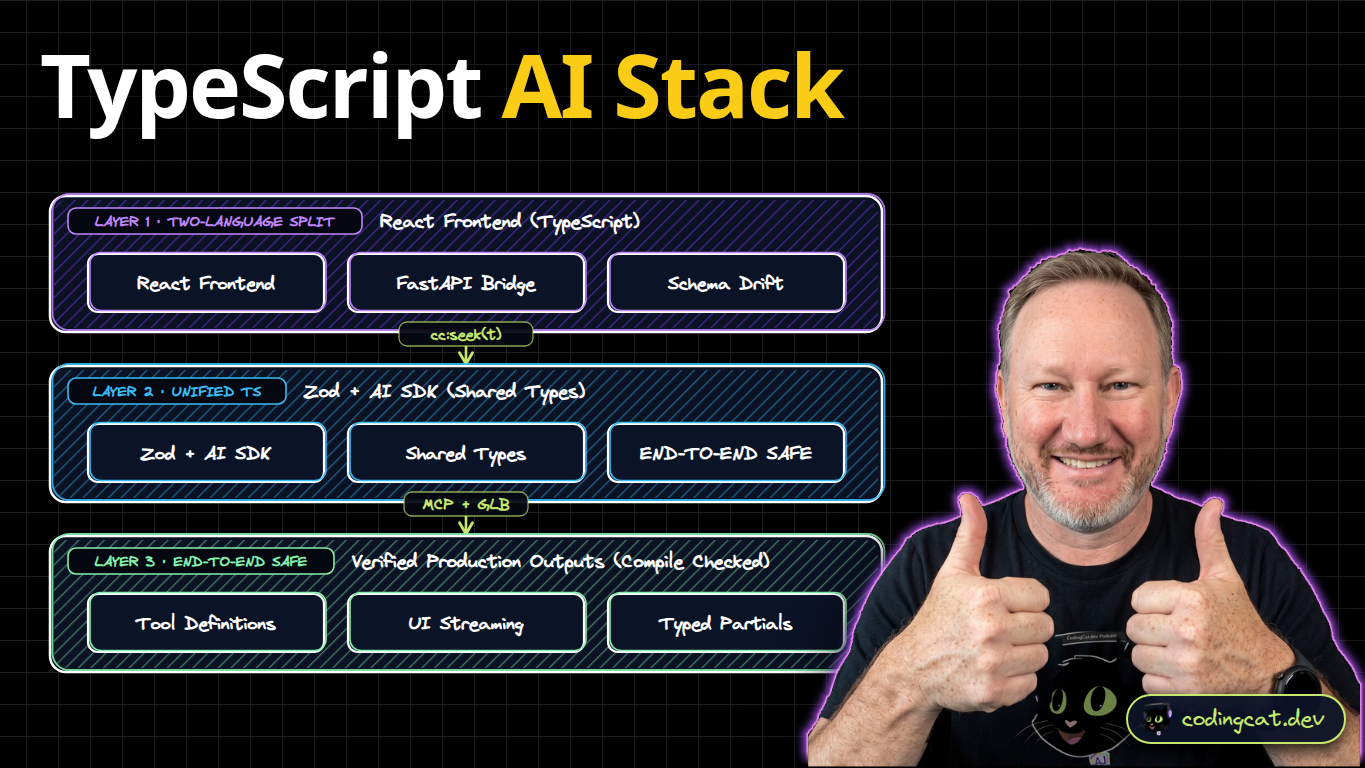
Why maintain a separate Python FastAPI microservice just to call an LLM over HTTP and stream JSON back to a TypeScript frontend? Let's look at why TypeScript won the AI application layer.
AI & AgentsTypeScriptCloudflare+2▶ Video + LessonStart Lesson → - 1.2Deterministic Agent Workflows vs. Autonomous Loops
Giving an LLM twenty tools and an open-ended while loop looks cool in a demo, right up until it spins for forty seconds and bills you four dollars for a single user question. Let's build deterministic agent workflows.
AI & AgentsTypeScriptCloudflare+2▶ Video + LessonStart Lesson → - 1.3Hybrid Web AI: Routing Between Browser Gemini Nano & Cloud Models
Why pay cloud token fees every time a user wants to summarize a paragraph or rewrite a comment when Chrome ships a local LLM right inside the browser? Let's build a Hybrid Web AI router in TypeScript.
AI & AgentsTypeScriptCloudflare+2▶ Video + LessonStart Lesson → - 1.4Serverless GPUs Without Dockerfiles (RunPod Flash)
Renting a dedicated GPU server twenty-four seven costs thousands of dollars a month when it sits idle ninety percent of the day. Here is how we dispatch per-second serverless GPUs directly from TypeScript.
AI & AgentsTypeScriptCloudflare+2▶ Video + LessonStart Lesson → - 1.5Agent Evals, Guardrails & Spend Caps in Production
Testing prompts by typing three examples into a chat box and hoping for the best is how teams ship regressions and wake up to runaway API bills. Let's wire up CI evals and hard spend caps in TypeScript.
AI & AgentsTypeScriptCloudflare+2▶ Video + LessonStart Lesson →
course overview.
1. Production Architecture Problem & Why We Built This Course
Architect deterministic tool-calling AI agents, multi-step workflows, hybrid browser-to-cloud routing, serverless GPU dispatch, and production eval guardrails in 100% TypeScript. In production engineering teams, the gap between a quick weekend demo and a resilient, multi-tenant system comes down to three architectural boundaries: cold-start latency, compile-time contract validation, and predictable operational cost. Throughout Full-Stack AI Agents in TypeScript (No Python Required), we strip away marketing buzzwords and build the exact TypeScript, edge compute, and structured data patterns that power CodingCat.dev in production.
Every lesson in this course pairs a dark-mode Architecture Diagram (contrasting the legacy anti-pattern on the left against the recommended 2026 production pattern on the right) with copy-pasteable TypeScript modules, automated verification checks, and an explicit Trade-Off Matrix. Whether you are reading the official AI SDK by Vercel: TypeScript Structured Outputs (generateObject / streamText) or pairing this course with our deep dive on Blog Post: Hybrid Web AI Architecture: Browser Gemini Nano + Cloud Workers, you can apply every pattern directly to your own repository today.
🐾 AJ's Course Architecture Rule: Never adopt a tool just because it trended on social media. Measure its cold start in milliseconds, verify its TypeScript schema boundary at compile time, and check what happens to your cloud bill when traffic spikes 100x.
2. Lesson-by-Lesson Architectural Walkthrough (5 Lessons)
Work through the lessons in sequence to build the complete system from first principles, or jump directly to the specific architectural boundary you are solving right now:
- Lesson 1: Why TypeScript Won the AI Application Layer: Replaces the
TWO-LANGUAGE SPLIT (React Frontend, FastAPI Bridge, Schema Drift)anti-pattern withZod + AI SDK -> Tool Definitions + UI Streaminginsidesrc/agents/course-advisor.ts. Why maintain a separate Python FastAPI microservice just to call an LLM over HTTP and stream JSON back to a TypeScript frontend? Let's look at why TypeScript won the AI application layer. - Lesson 2: Deterministic Agent Workflows vs. Autonomous Loops: Replaces the
WHILE(TRUE) LOOP (25 Tool Calls, $4.50 / Request, 45s Timeout)anti-pattern withState Machine -> Classify -> Fetch + Synthesizeinsidesrc/agents/workflow.ts. Giving an LLM twenty tools and an open-ended while loop looks cool in a demo, right up until it spins for forty seconds and bills you four dollars for a single user question. Let's build deterministic agent workflows. - Lesson 3: Hybrid Web AI: Routing Between Browser Gemini Nano & Cloud Models: Replaces the
100% CLOUD API (Every Keystroke, Network Hop, Privacy Data)anti-pattern withHybrid Router -> Gemini Nano + Cloud Frontierinsidesrc/agents/hybrid-router.ts. Why pay cloud token fees every time a user wants to summarize a paragraph or rewrite a comment when Chrome ships a local LLM right inside the browser? Let's build a Hybrid Web AI router in TypeScript. - Lesson 4: Serverless GPUs Without Dockerfiles (RunPod Flash): Replaces the
IDLE GPU SERVER (24/7 A100 VM, 15GB CUDA Img, Worker Timeout)anti-pattern withTyped Queue -> Burst Workers + Webhook Syncinsidesrc/agents/gpu-dispatch.ts. Renting a dedicated GPU server twenty-four seven costs thousands of dollars a month when it sits idle ninety percent of the day. Here is how we dispatch per-second serverless GPUs directly from TypeScript. - Lesson 5: Agent Evals, Guardrails & Spend Caps in Production: Replaces the
VIBES DEPLOY (Prompt Edit, Bot Abuse, PII Leak)anti-pattern withEval + Budget -> Golden Dataset + D1 Spend Capinsidesrc/agents/budget-guard.ts. Testing prompts by typing three examples into a chat box and hoping for the best is how teams ship regressions and wake up to runaway API bills. Let's wire up CI evals and hard spend caps in TypeScript.
3. Alex's 2026 Ecosystem & Architectural Tier List
Before writing a single line of configuration, you need to know how the available platforms and patterns stack up in real production environments. Here is how I rank the ecosystem from S-Tier (our default production choice on CodingCat.dev) down to D-Tier anti-patterns to avoid:
Alex's 2026 AI Agent Engineering Architecture Tier List
Ranking 5 approaches to building production AI features across latency predictability, schema safety, and gross-margin protection.
Deterministic TypeScript State Machine + Zod + D1 Token Budget Guard ↗
Bounded Production WorkflowBreaks AI features into explicit Classify -> Parallel MCP/DB Fetch -> Grounded Synthesis steps in TypeScript, capped by per-user daily token budgets in Cloudflare D1.
Hybrid Browser Gemini Nano + Cloud Frontier Escalation ↗
Client-First Hybrid Web AIExecutes routine summaries, draft rewrites, and classification on the user's local GPU via Chrome's LanguageModel API, escalating only complex tool tasks to the cloud.
Edge Worker Async Dispatch to Per-Second Serverless GPUs ↗
Burst Media & Voice ComputeDispatches heavy image, video, or TTS synthesis jobs asynchronously via webhook callbacks so edge workers never block and you pay strictly for active GPU seconds.
Split TypeScript Frontend + Python FastAPI LLM Proxy
Two-Language Microservice SplitForces product teams to duplicate Pydantic and TypeScript schemas and pay for an extra container hop just to call an external HTTP LLM API.
Unbounded Autonomous while(true) Loop with Uncapped API Key
Demo-Ware Anti-PatternSpins for 45 seconds calling tools in circles when an upstream API returns an unexpected error, burning $4+ on a single user prompt.
4. Production Starter Configuration & Local Setup
To follow along with the code examples in Full-Stack AI Agents in TypeScript (No Python Required), start with this baseline src/agents/pipeline.ts configuration. It enables strict TypeScript verification, observability tracing, and local development bindings that match production 1-to-1:
import { generateObject } from "ai";
import { z } from "zod";

export const AgentPlanSchema = z.object({
  intent: z.enum(["course_lookup", "code_explain", "architecture_review"]),
  searchQuery: z.string().min(2),
  requiresCloudReasoning: z.boolean(),
  maxTokenBudget: z.number().int().min(256).max(4096),
});

export type AgentPlan = z.infer<typeof AgentPlanSchema>;
5. Course-Wide Production Trade-Off Matrix
Every architectural decision involves trade-offs. Use this reference table during design reviews with your team to justify why we choose edge-native TypeScript, explicit schema validation, and deterministic workflows over legacy alternatives:
| Architectural Dimension | 2026 CodingCat.dev Course Pattern | Legacy Industry Default | Production Impact at Scale |
|---|---|---|---|
| Compute & Cold Starts | V8 Isolates / Native Browser Compositor (< 5ms) | Heavy Container VMs / Main-Thread JS Bloat (500ms+) | Eliminates tail-latency spikes on every request and interaction. |
| Contract & Type Safety | End-to-End TypeScript + Zod / GROQ TypeGen | Untyped JSON payloads & manual interface drift | Catches breaking schema changes in CI before deployment. |
| State & Database Topology | Cloudflare D1 Batch / Durable SQLite / Sanity Content Lake | Exhausted TCP pools & unindexed N+1 loops | Predictable sub-10ms reads with zero connection pool errors. |
| Security & Multi-Tenancy | OAuth 2.1 PKCE + Better-Auth Scoped Sessions | Shared static API keys & unescaped DOM strings | Zero-trust tenant isolation and $0 per-MAU SaaS tax. |
| AI & Agent Readiness | Streamable HTTP MCP + WebMCP + RFC 9727 + Daily Spend Caps | 20k-token headless DOM scraping & uncapped retry loops | Cuts token spend by 95%+ while preventing runaway bills. |
6. Official Specifications, Docs & Related CodingCat.dev Deep Dives
Bookmark these official specifications and related CodingCat.dev Courses, Blog Posts, and Podcast Episodes as you work through the lessons:
- Blog Post: Hybrid Web AI Architecture: Browser Gemini Nano + Cloud Workers: Complete routing heuristics between $0 on-device Gemini Nano and cloud frontier models.
- Blog Post: Chrome Built-in AI and Gemini Nano Production Guide: Deep dive into the browser LanguageModel, Summarizer, and Rewriter APIs.
- Blog Post: Dockerless Serverless GPUs with RunPod Flash: How to burst-render thousands of images or audio clips for pennies without maintaining CUDA Dockerfiles.
- Blog Post: Eval-Driven Development for AI Agent Skills: Replacing vibes-based prompt tweaking with deterministic CI evaluation suites.
- Blog Post: Enforcing Cloud & AI Spend Caps in Production: Architectural patterns for hard token budgets and circuit breakers.
- AI SDK by Vercel: TypeScript Structured Outputs (generateObject / streamText): Unified TypeScript interface for Zod-constrained outputs, tool calling, and UI streaming.
- Zod TypeScript-First Schema Validation Documentation: Single source of truth for LLM JSON schemas, API payloads, and React component props.
- Chrome Built-in AI (Prompt API / LanguageModel) Developer Docs: Running Gemini Nano locally inside Chrome with zero cloud inference cost.
- Google Gemini API Documentation: Structured Outputs & Function Calling: Multi-modal reasoning, context caching, and deterministic schema enforcement.
Ready to write code? Jump straight into Lesson 1: Why TypeScript Won the AI Application Layer →
how this course connects together.
Follow AJ through the layered stack topology from input contract to production output.