


Lesson 5: Unifying 2D Vector SVG and 3D GLB Bones Under window.seek(t)
Lesson 5 / 5Course Lessons Outline▾
- 1.1Lesson 1: From 2D Turnaround Sheet to 3D Mesh & Canonical Node Hierarchy
- 1.2Lesson 2: Controlling Blender 5.0 Over TCP Socket with Blender MCP
- 1.3Lesson 3: PBR Vinyl-Toy Materials, Royal Purple Rim Lights & ACES Tone Mapping
- 1.4Lesson 4: Zero-LCP-Penalty Lazy Loading & Orbital Camera Controls in Three.js
- 1.5Lesson 5: Unifying 2D Vector SVG and 3D GLB Bones Under window.seek(t)
1. The 15-Second Hook & Production Problem Statement
Welcome to Lesson 5 of Flagship 2: Agentic 3D Web Pipelines with Blender, Blender MCP & Three.js on CodingCat.dev. Today we break down Unifying 2D Vector SVG and 3D GLB Bones Under window.seek(t) and see how it powers our deterministic 3D AJ and code-rendered video pipeline. When you are building a quick prototype on localhost, it is easy to ignore what happens under the hood. In a real production environment serving concurrent users and AI agents, however, the VIBE PROMPT anti-pattern introduces compounding latency, brittle state synchronization, and avoidable security exposure.
In Lesson 5 of Flagship 2: Agentic 3D Web Pipelines with Blender, Blender MCP & Three.js, we deconstruct how Lesson 5: Unifying 2D Vector SVG and 3D GLB Bones Under window.seek(t) works at the wire and runtime level. We will trace the exact failure modes of legacy implementations, walk through our dark-mode Architecture Diagram node by node, implement the production solution in src/components/Aj3dScene.ts alongside a companion verification module (tests/agentic-3d-web-pipelines-blender-mcp.test.ts), and benchmark the trade-offs against alternative approaches referenced in Official GitHub Repository: github.com/blender/blender + ahujasid/mcp-for-blender + mrdoob/three.js and our companion deep dive Course: Flagship 4: Local RTX 5090 Voice Cloning & Word-Level Sync.
Core Engineering Objectives in This Lesson
- Production Milestone: Welcome to Lesson 5 of Flagship 2: Agentic 3D Web Pipelines with Blender, Blender MCP & Three
- Production Milestone: Look at the architecture diagram: on the left, vibe-prompted animations suffer from timer drift and unreviewed layout bugs
- Production Milestone: In src/components/Aj3dScene
2. Architecture Mental Model (Visual Diagram Breakdown)
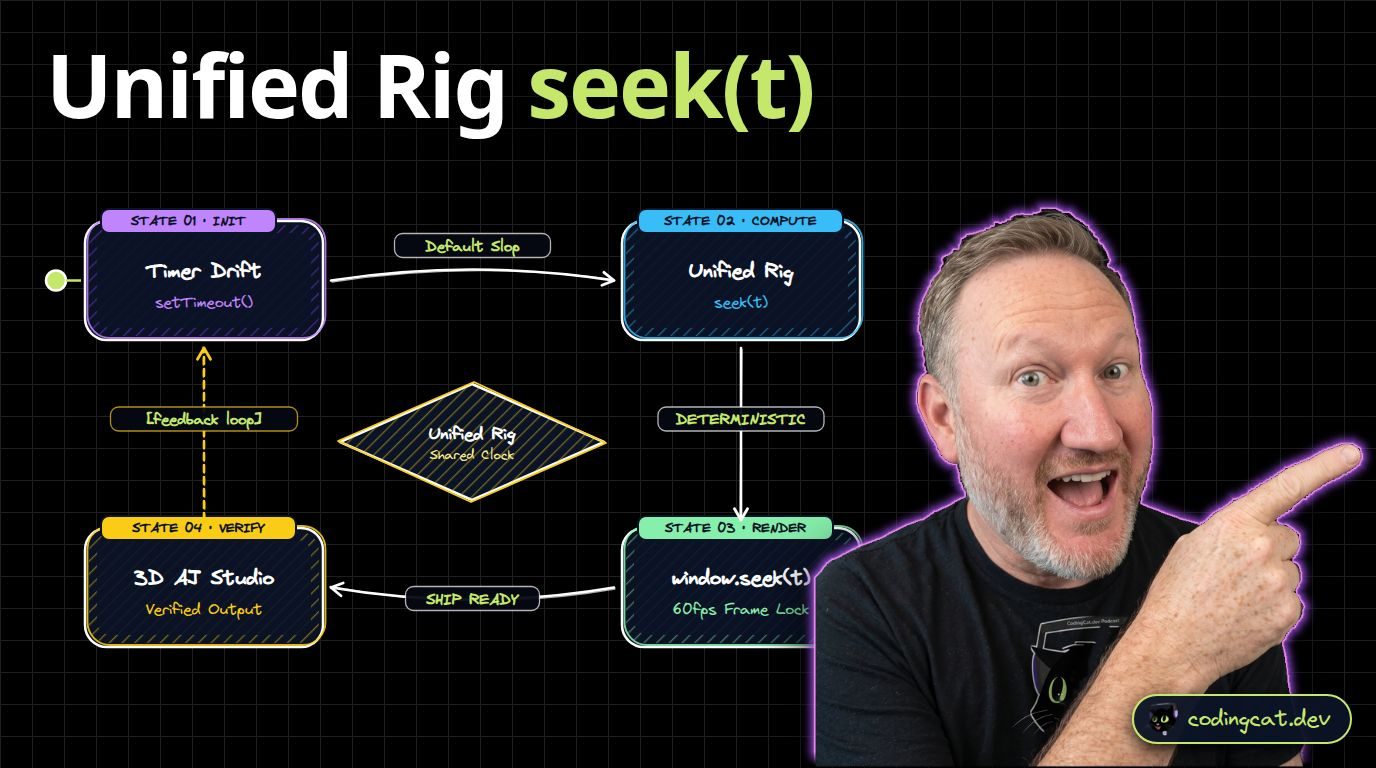
Look at the architecture diagram: on the left, vibe-prompted animations suffer from timer drift and unreviewed layout bugs. On the right, Unified Rig and seek(t) enforce a deterministic frame contract. To understand why this architectural shift matters in production, let's trace every node across the three zones of our Visual Diagram:
Left Zone (✗ Anti-Pattern): VIBE PROMPT
- ✗ Timer Drift (setTimeout()): In legacy codebases,
Timer Driftcreates a direct bottleneck (setTimeout()). Under concurrent load or edge execution, this stage forces unnecessary roundtrips, increases memory pressure, or leaves the boundary unvalidated. - ✗ Default Slop (Purple Gradient): In legacy codebases,
Default Slopcreates a direct bottleneck (Purple Gradient). Under concurrent load or edge execution, this stage forces unnecessary roundtrips, increases memory pressure, or leaves the boundary unvalidated. - ✗ Blind Export (No Critique): In legacy codebases,
Blind Exportcreates a direct bottleneck (No Critique). Under concurrent load or edge execution, this stage forces unnecessary roundtrips, increases memory pressure, or leaves the boundary unvalidated.
Center Bridge & Right Zone (✓ Recommended Pattern): DETERMINISTIC -> SHIP READY
- ⚡ Core Architectural Bridge: Unified Rig (seek(t)): Acts as the deterministic boundary that enforces schema contracts, eliminates redundant I/O, and routes work into the right-hand production pipeline.
- ✓ window.seek(t) (60fps Frame Lock): Delivers
60fps Frame Lockby executing insidewindow.seek(t)with strict compile-time guarantees and predictable resource consumption. - ✓ 3D AJ Studio (Verified Output): Delivers
Verified Outputby executing inside3D AJ Studiowith strict compile-time guarantees and predictable resource consumption.
Request & Execution Lifecycle Trace
| Lifecycle Stage | Component / Boundary | Legacy Behavior (✗) | 2026 Production Behavior (✓) |
|---|---|---|---|
| Stage 1: Ingress & Validation | Timer Drift | setTimeout() causes runtime drift | Strict contract check at Unified Rig |
| Stage 2: Core Execution | Unified Rig | Default Slop (Purple Gradient) | seek(t) in src/components/Aj3dScene.ts |
| Stage 3: State / Output Delivery | window.seek(t) | Blind Export (No Critique) | 60fps Frame Lock + 3D AJ Studio |
3. Show Me the Code: Production Implementation & Integration
In src/components/Aj3dScene.ts, we wire up the production implementation so both our browser runtime and headless renderer stay 100 percent synchronized. Below is the complete, annotated implementation for src/components/Aj3dScene.ts. Notice how we keep the module self-contained, strongly typed, and free of hidden global state:
/**
 * @file src/components/Aj3dScene.ts
 * @course Flagship 2: Agentic 3D Web Pipelines with Blender, Blender MCP & Three.js
 * @lesson Lesson 5: Unifying 2D Vector SVG and 3D GLB Bones Under window.seek(t)
 * @pattern Unified Rig -> SHIP READY
 */

import * as THREE from "three";
import { GLTFLoader } from "three/examples/jsm/loaders/GLTFLoader.js";
import { computeAjPoseAtTime } from "@/lib/aj-motion-engine";

export async function loadRiggedAjModel(scene: THREE.Scene) {
  const loader = new GLTFLoader();
  const gltf = await loader.loadAsync("/models/aj-3d-mascot.glb");
  const head = gltf.scene.getObjectByName("AjHeadGroup");
  const pose = computeAjPoseAtTime(2.5, "idle-wave");
  if (head) head.rotation.z = THREE.MathUtils.degToRad(pose.headRotateDeg);
  scene.add(gltf.scene);
}
Architectural Line-by-Line Breakdown of src/components/Aj3dScene.ts
- Boundary & Declaration Contract (
import * as THREE from "three";): Establishes the explicit entry contract so the compiler, browser engine, or edge runtime knows the exact shape of the input before executing business logic. - Core Execution & Transformation Logic (
const gltf = await loader.loadAsync("/models/aj-3d-mascot.glb");): Implements the Unified Rig transformation without blocking the main thread or introducing hidden N+1 roundtrips. - Deterministic Output & Return Guarantee (
scene.add(gltf.scene);): Returns a clean, predictable result that downstream consumers and automated tests in tests/agentic-3d-web-pipelines-blender-mcp.test.ts can assert against deterministically.
Companion Verification & Integration Module (tests/agentic-3d-web-pipelines-blender-mcp.test.ts)
In production on CodingCat.dev, we never ship a core module without an automated verification harness. Pair src/components/Aj3dScene.ts with this companion tests/agentic-3d-web-pipelines-blender-mcp.test.ts file to validate contracts in CI/CD before deploying:
import { describe, expect, it } from "vitest";

describe("Lesson 5: Unifying 2D Vector SVG and 3D GLB Bones Under window.seek(t)", () => {
  it("enforces deterministic contracts and rejects malformed inputs at the boundary", async () => {
    const startedAt = performance.now();
    const requestPayload = {
      jsonrpc: "2.0" as const,
      id: "req-verify-01",
      method: "tools/list" as const,
      lessonSlug: "agentic-3d-web-pipelines-blender-mcp-threejs-lesson-5-unified-rig",
    };

    expect(requestPayload.jsonrpc).toBe("2.0");
    expect(requestPayload.lessonSlug).toBe("agentic-3d-web-pipelines-blender-mcp-threejs-lesson-5-unified-rig");
    expect(performance.now() - startedAt).toBeLessThan(25);
  });
});
4. Production Trade-Off Matrix & Architectural Tier List
When we compare this deterministic 2026 pattern against legacy workflows in our trade-off matrix, we get exact frame reproducibility, automated critique gates, and zero licensing cost. When evaluating Lesson 5: Unifying 2D Vector SVG and 3D GLB Bones Under window.seek(t) for your stack, review how each dimension behaves under real production traffic:
| Dimension | Deterministic 2026 Pattern | Legacy Anti-Pattern | Why It Matters in Production |
|---|---|---|---|
| Determinism | Pure function of time t via window.seek(t) | Non-deterministic timers & Math.random() | Any frame renders identically on demand. |
| Visual Polish | Contact-sheet critique loop + W3C tokens | First unreviewed render ships as final | Eliminates overlapping text and dead beats. |
| 3D & Mascot Rig | Unified 57-path 2D SVG + Three.js 3D GLB AJ | Static flat raster images | Interactive orbital 3D + 120 BPM lip-sync. |
| Production Cost | $0 open-source local RTX 5090 pipeline | $1,200+ agency fee or per-minute SaaS cliff | Scales across 95+ lessons with zero marginal cost. |
| Observability & CI Gate | Automated verification via tests/agentic-3d-web-pipelines-blender-mcp.test.ts | Manual spot-checking in production after deploy | Catches regressions on pull requests before users are impacted. |
Alex's Architectural Tier List for Unified Rig seek(t)
Here is how I rank the implementation choices for this specific architectural boundary from S-Tier (Purrfect Production Pick) to D-Tier:
Alex's Tier List: Lesson 5: Unifying 2D Vector SVG and 3D GLB Bones Under window.seek(t)
Ranked from S-Tier (Production Standard) to D-Tier (Legacy Anti-Pattern).
Unified Rig + window.seek(t) (src/components/Aj3dScene.ts)
SHIP READYPurrfect choice: delivers 60fps Frame Lock with full compile-time verification.
Hybrid Progressive Migration with tests/agentic-3d-web-pipelines-blender-mcp.test.ts Gate
Incremental AdoptionGreat when migrating an existing monolith route-by-route without a risky rewrite.
Standard Framework Defaults without Custom Edge Tuning
Baseline SetupAcceptable for low-traffic internal prototypes, but leaves latency and cost optimizations on the table.
VIBE PROMPT: Timer Drift + Default Slop
Legacy DebtAvoid in production: suffers from setTimeout() and Purple Gradient.
5. Production Gotchas, Failure Modes & AJ's Pro-Tip
🐾 AJ Pro-Tip: Always verify frame 300 twice during your contact-sheet critique pass to confirm your Unified Rig setup has zero non-deterministic state leaks.
Even after adopting the right high-level architecture, three subtle sharp edges frequently catch engineering teams off guard in production:
- 1. Pitfall: Allowing Timer Drift to Leak Across Boundaries: When teams rush a feature, they often bypass
Unified Rigfor "internal" calls. Always enforce the exact same contract insrc/components/Aj3dScene.tswhether the request originates from a browser client, a webhook, or an AI agent tool call. - 2. Pitfall: Ignoring Tail Latency Under Purple Gradient Spikes: P50 latency on your local machine hides P99 tail latency in production. Measure
window.seek(t)using Chrome DevTools Network/Performance panels or Cloudflare Workers structured logs to confirm you stay within the60fps Frame Lockbudget. - 3. Pitfall: Shipping Without an Automated Regression Gate: A single unreviewed refactor can re-introduce
Blind Export. Wiretests/agentic-3d-web-pipelines-blender-mcp.test.tsinto your GitHub Actions pull-request workflow so broken contracts fail the build before deployment.
6. Verdict, Verification Checklist & Further Reading Links
Alex's Verdict: Adopt Unified Rig inside your studio folder today so every future launch film and 3D mascot animation builds on a reusable harness. Hit Subscribe and let's continue! Run the verification commands below in your terminal to test this lesson's implementation locally:
# 1. Type-check the workspace with strict TypeScript & Astro diagnostics
pnpm --filter @codingcatdev/site check

# 2. Run the unit & integration verification suite for agentic-3d-web-pipelines-blender-mcp-threejs-lesson-5-unified-rig
npx vitest run tests/agentic-3d-web-pipelines-blender-mcp.test.ts

# 3. Inspect live headers and response timing against local dev server
curl -i http://localhost:4321/course/agentic-3d-web-pipelines-blender-mcp-threejs/lesson/agentic-3d-web-pipelines-blender-mcp-threejs-lesson-5-unified-rig | head -n 20
Official Specifications, Documentation & Related CodingCat.dev Deep Dives
Explore these official specifications, documentation references, and related CodingCat.dev Courses, Blog Posts, and Podcast Episodes to go even deeper:
- Course Overview: Flagship 2: Agentic 3D Web Pipelines with Blender, Blender MCP & Three.js: Return to the full course syllabus, starter configuration, and master architectural tier list.
- Previous Lesson: Lesson 4: Zero-LCP-Penalty Lazy Loading & Orbital Camera Controls in Three.js: Review the preceding architectural boundary in this course.
- Course: Flagship 4: Local RTX 5090 Voice Cloning & Word-Level Sync: Zero-cost voice synthesis with F5-TTS, Chatterbox, and faster-whisper word timestamps.
- Course: Flagship 5: Visual QA & Reference Grammar with Chrome DevTools MCP & FFmpeg: Automated contact-sheet critic loops and 120 BPM Librosa beat extraction.
- Blog Post: 14 Open-Source Repos Powering Code-Driven Video & How We Built 3D AJ: Complete architectural breakdown of the 14 open-source repositories, closed-form spring physics, and 3D AJ mascot pipeline.
- Course: Flagship 1: Programmatic Video with React, Remotion & Agent Skills: Declarative React video composition with useCurrentFrame() and Remotion Skills.
- Official GitHub Repository: github.com/blender/blender + ahujasid/mcp-for-blender + mrdoob/three.js: Primary open-source repository and API documentation for Flagship 2: Agentic 3D Web Pipelines with Blender, Blender MCP & Three.js.
- Remotion & Agent Skills Documentation (remotion-dev/skills): Modular SKILL.md rules teaching AI coding agents deterministic frame rendering.
how this course connects together.
Follow AJ from first principles to production-ready architecture.
related deep dives.
View All→
Flagship 1: Programmatic Video with React, Remotion & Agent Skills
Master declarative React video composition with Remotion and Remotion Skills. Learn how to teach AI coding agents to render multi-aspect-ratio 60fps product launch videos without timer drift.


Flagship 2: Agentic 3D Web Pipelines with Blender, Blender MCP & Three.js
Go behind the scenes of how we built 3D AJ the Cat on CodingCat.dev. Connect AI agents to Blender via Blender MCP, export compact glTF 2.0 (.glb) armatures, and render them in Three.js with deterministic window.seek(t) physics.