Real-Time Streaming & WebSocket Hibernation with the Cloudflare Agents SDK
1. The 15-Second Hook
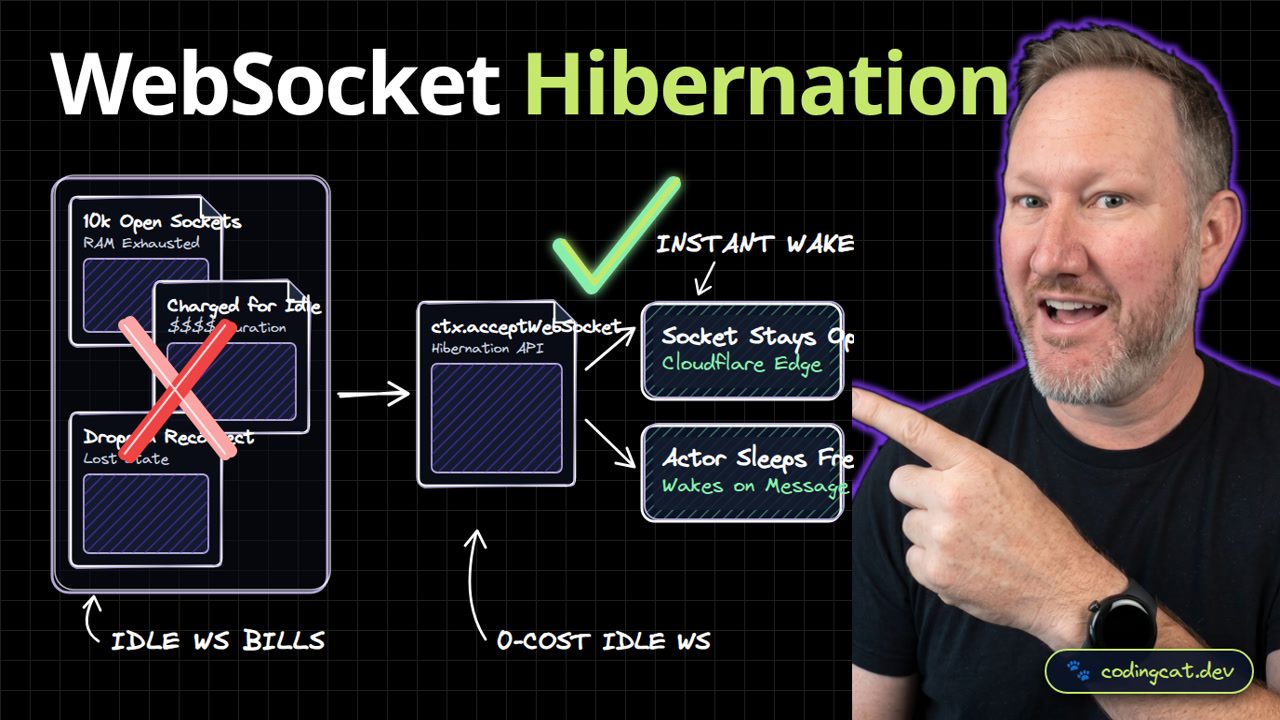
Keeping ten thousand WebSockets open to an AI agent used to mean paying for idle server memory all day long. Let's see how WebSocket Hibernation and the Cloudflare Agents SDK keep sockets open while billing zero during idle pauses.
2. Architecture Mental Model (Visual Diagram)
On the left, traditional WebSocket servers bill for idle wall-clock duration while users read responses. On the right, Cloudflare's edge holds the WebSocket connection while your Agent Durable Object hibernates for free and wakes instantly on message.
3. Show Me the Code (src/agents/codingcat-agent.ts)
import { Agent } from "agents";

export class CodingCatAgent extends Agent<Env, { count: number }> {
  onConnect(connection: any) {
    connection.send(JSON.stringify({ type: "connected", state: this.state }));
  }
  async onMessage(connection: any, message: string) {
    const next = (this.state?.count || 0) + 1;
    this.setState({ count: next });
    connection.send(JSON.stringify({ type: "ack", count: next }));
  }
}
In src/agents/codingcat-agent.ts, extending the Agent class gives us onConnect, onMessage, and automatic state persistence and client broadcasting via this.setState.
4. Production Trade-Off Matrix
Comparing the Cloudflare Agents SDK with WebSocket Hibernation against always-on socket servers, you eliminate idle duration billing and get built-in SQLite state and alarms.
5. Verdict & AJ Pro-Tip
AJ Pro-Tip: Use this.schedule() inside your Agent class whenever an agent needs to check on a long-running background task or send a follow-up reminder minutes or hours later.
That completes our Cloudflare Agents and Durable Objects deep dive! Hit Subscribe to help CodingCat.dev reach 100K subscribers, and watch for tomorrow's new 2026 course!
how this course connects together.
Follow AJ from first principles to production-ready architecture.