The Zero-Cold-Start Edge Stack: Astro 7, Cloudflare Workers, D1 & Better-Auth
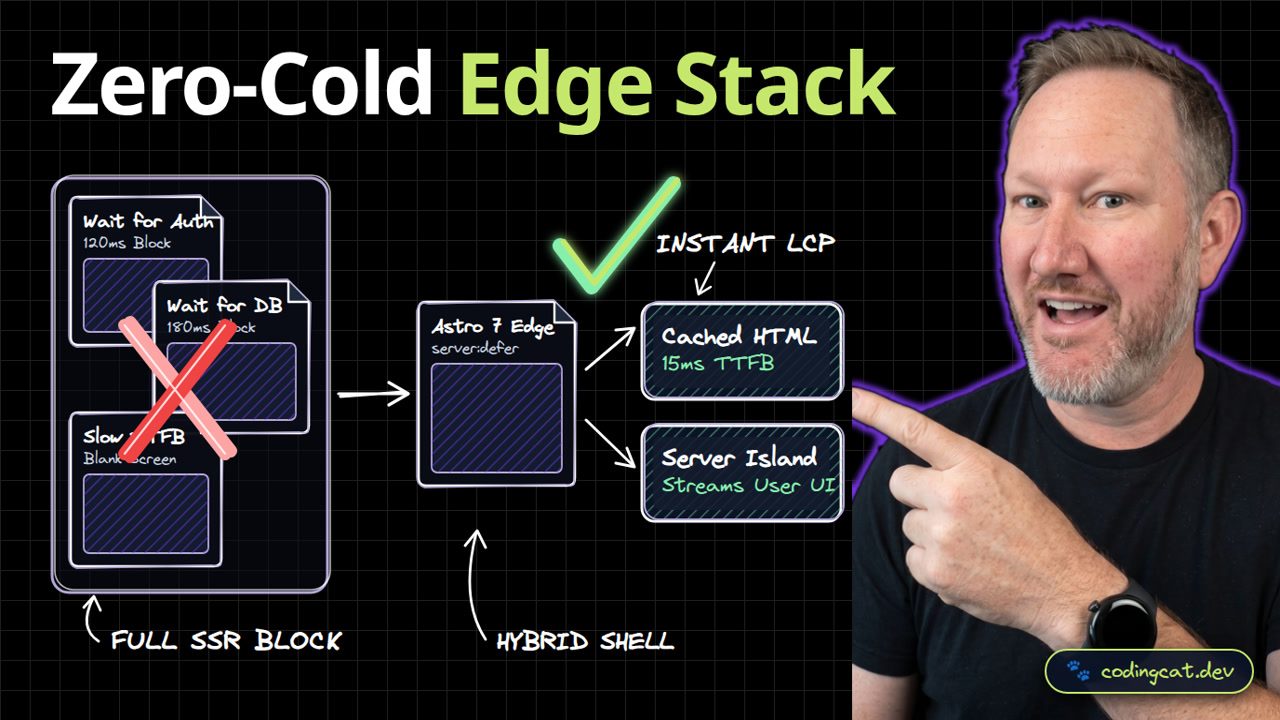
1. Production Architecture Problem & Why We Built This Course
Ship sub-10ms full-stack TypeScript web applications at the edge using Astro 7 Server Islands, Cloudflare Workers V8 Isolates, Cloudflare D1 SQLite, and self-hosted Better-Auth. In production engineering teams, the gap between a quick weekend demo and a resilient, multi-tenant system comes down to three architectural boundaries: cold-start latency, compile-time contract validation, and predictable operational cost. Throughout The Zero-Cold-Start Edge Stack: Astro 7, Cloudflare Workers, D1 & Better-Auth, we strip away marketing buzzwords and build the exact TypeScript, edge compute, and structured data patterns that power CodingCat.dev in production.
Every lesson in this course pairs a dark-mode Architecture Diagram (contrasting the legacy anti-pattern on the left against the recommended 2026 production pattern on the right) with copy-pasteable TypeScript modules, automated verification checks, and an explicit Trade-Off Matrix. Whether you are reading the official Astro Official Documentation: Server Islands (server:defer) & Cloudflare Adapter or pairing this course with our deep dive on Blog Post: Hybrid Web AI Architecture on Edge Workers, you can apply every pattern directly to your own repository today.
🐾 AJ's Course Architecture Rule: Never adopt a tool just because it trended on social media. Measure its cold start in milliseconds, verify its TypeScript schema boundary at compile time, and check what happens to your cloud bill when traffic spikes 100x.
2. Lesson-by-Lesson Architectural Walkthrough (5 Lessons)
Work through the lessons in sequence to build the complete system from first principles, or jump directly to the specific architectural boundary you are solving right now:
- Lesson 1: Why V8 Isolates Beat Containers at the Edge (<5ms Cold Starts): Replaces the
CONTAINER COLD (Linux Guest OS, Node Process, 1 Region Only)anti-pattern withworkerd Engine -> 300+ Edge PoPs + Web Standardsinsidesrc/worker-entry.ts. Why spin up an entire Linux container just to run fifty lines of TypeScript middleware? Let's look at how V8 Isolates deliver sub-five-millisecond cold starts across three hundred global edge locations. - Lesson 2: Astro 7 Server Islands & Cloudflare Workers Setup (wrangler.jsonc): Replaces the
FULL SSR BLOCK (Wait for Auth, Wait for DB, Slow TTFB)anti-pattern withAstro 7 Edge -> Cached HTML + Server Islandinsidewrangler.jsonc. Blocking an entire tutorial page just to check if a user is logged in destroys your Largest Contentful Paint. Here is how Astro 7 Server Islands and Cloudflare Workers give you cached speed and live personalization. - Lesson 3: SQLite at the Edge with Cloudflare D1: Replaces the
TCP POOL HELL (TLS Handshake, Pool Exhausted, VPC NAT Bill)anti-pattern withenv.DB Binding -> Prepared SQL + env.DB.batch()insidesrc/lib/db.ts. Connecting thousands of stateless edge isolates to a traditional Postgres server over TCP quickly exhausts your connection pool. Here is how Cloudflare D1 brings transactional SQLite directly to the edge. - Lesson 4: Self-Hosted Edge Authentication with Better-Auth & D1: Replaces the
AUTH SAAS TAX (Per-MAU Cliff, External Users, Extra Hop)anti-pattern withBetter-Auth -> OAuth + Magic + Users in D1insidesrc/lib/auth.ts. Why pay a third-party auth provider hundreds of dollars a month and maintain fragile user-sync webhooks when your auth tables can live right inside Cloudflare D1? Let's set up Better-Auth at the edge. - Lesson 5: Zero-Downtime CI/CD & Observability on Cloudflare: Replaces the
BLIND DEPLOYS (Manual CLI, 0% E2E Gate, No Traces)anti-pattern withGitHub Actions -> Gradual Rollout + Workers Logsinsidewrangler.jsonc (observability). Deploying to the edge in three seconds is awesome until a missing environment binding breaks production and you have zero logs to debug it. Let's wire up zero-downtime CI/CD and Cloudflare observability.
3. Alex's 2026 Ecosystem & Architectural Tier List
Before writing a single line of configuration, you need to know how the available platforms and patterns stack up in real production environments. Here is how I rank the ecosystem from S-Tier (our default production choice on CodingCat.dev) down to D-Tier anti-patterns to avoid:
Alex's Full-Stack Edge Deployment & Runtime Tier List (2026)
Ranking 5 full-stack web architectures by TTFB, cold-start behavior, database connection topology, and auth cost at 100k MAU.
Astro 7 Server Islands + Cloudflare Workers + D1 + Better-Auth ↗
Zero-Cold-Start Edge StackCaches 95% of HTML at 300+ edge PoPs for sub-20ms TTFB while streaming dynamic user state via server:defer islands backed by local D1 SQLite and Better-Auth.
Hono RPC + TanStack Start on Cloudflare Workers ↗
Type-Safe App-Heavy Edge StackWhen building highly interactive client dashboards with complex URL search state, Hono RPC paired with TanStack Start delivers end-to-end TypeScript inference.
Single-Region Next.js SSR + Regional Postgres + Managed Auth SaaS ↗
Traditional Cloud SSR StackSolid developer ecosystem, but blocking full-page SSR on regional database roundtrips and third-party auth API hops adds 200ms+ to global TTFB.
Client-Only SPA with Uncached REST Waterfalls
Legacy CSR ArchitectureShips 300KB+ of JavaScript before rendering a blank loading spinner, hurting SEO, AI agent readability, and mobile Largest Contentful Paint.
4. Production Starter Configuration & Local Setup
To follow along with the code examples in The Zero-Cold-Start Edge Stack: Astro 7, Cloudflare Workers, D1 & Better-Auth, start with this baseline astro.config.mjs configuration. It enables strict TypeScript verification, observability tracing, and local development bindings that match production 1-to-1:
import { defineConfig } from "astro/config";
import cloudflare from "@astrojs/cloudflare";
import tailwindcss from "@tailwindcss/vite";

export default defineConfig({
  site: "https://codingcat.dev",
  output: "server",
  adapter: cloudflare({
    platformProxy: { enabled: true },
    imageService: "passthrough",
  }),
  vite: {
    plugins: [tailwindcss()],
  },
});
5. Course-Wide Production Trade-Off Matrix
Every architectural decision involves trade-offs. Use this reference table during design reviews with your team to justify why we choose edge-native TypeScript, explicit schema validation, and deterministic workflows over legacy alternatives:
| Architectural Dimension | 2026 CodingCat.dev Course Pattern | Legacy Industry Default | Production Impact at Scale |
|---|---|---|---|
| Compute & Cold Starts | V8 Isolates / Native Browser Compositor (< 5ms) | Heavy Container VMs / Main-Thread JS Bloat (500ms+) | Eliminates tail-latency spikes on every request and interaction. |
| Contract & Type Safety | End-to-End TypeScript + Zod / GROQ TypeGen | Untyped JSON payloads & manual interface drift | Catches breaking schema changes in CI before deployment. |
| State & Database Topology | Cloudflare D1 Batch / Durable SQLite / Sanity Content Lake | Exhausted TCP pools & unindexed N+1 loops | Predictable sub-10ms reads with zero connection pool errors. |
| Security & Multi-Tenancy | OAuth 2.1 PKCE + Better-Auth Scoped Sessions | Shared static API keys & unescaped DOM strings | Zero-trust tenant isolation and $0 per-MAU SaaS tax. |
| AI & Agent Readiness | Streamable HTTP MCP + WebMCP + RFC 9727 + Daily Spend Caps | 20k-token headless DOM scraping & uncapped retry loops | Cuts token spend by 95%+ while preventing runaway bills. |
6. Official Specifications, Docs & Related CodingCat.dev Deep Dives
Bookmark these official specifications and related CodingCat.dev Courses, Blog Posts, and Podcast Episodes as you work through the lessons:
- Blog Post: Hybrid Web AI Architecture on Edge Workers: How Cloudflare Workers V8 isolates coordinate low-latency edge routes and client AI capabilities.
- Blog Post: Architecting the Agent-Ready Web with Astro and Cloudflare Workers: Real production patterns from the CodingCat.dev Astro + Cloudflare Workers codebase.
- Course: MCP in Production on Cloudflare Workers: Extend your Zero-Cold-Start Edge Stack with OAuth 2.1 protected Model Context Protocol endpoints.
- Course: Cloudflare Agents, Durable Objects & Stateful Workflows: Add per-room embedded SQLite actors and WebSocket hibernation to your stateless Workers.
- Course: The Odin Project 7: Relational Databases, SQL Indexing & Drizzle ORM: Deep dive into B-Tree composite indexes and Drizzle ORM migrations on Cloudflare D1.
- Astro Official Documentation: Server Islands (server:defer) & Cloudflare Adapter: Streaming personalized server components into edge-cached static HTML shells.
- Cloudflare Workers Documentation: How V8 Isolates and workerd Work: Architectural breakdown of shared V8 engine isolates versus container virtualization.
- Cloudflare D1 SQLite Documentation: Batch API, Read Replication & Time Travel: Parameterized queries, atomic env.DB.batch() transactions, and point-in-time recovery.
- Better-Auth Documentation: Self-Hosted TypeScript Auth on Cloudflare D1: Zero-surcharge user, session, OAuth, and Passkey tables inside your own SQLite database.
Ready to write code? Jump straight into Lesson 1: Why V8 Isolates Beat Containers at the Edge (<5ms Cold Starts) →
course lessons.
Core Architecture & Production Implementation
- 1.1Why V8 Isolates Beat Containers at the Edge (<5ms Cold Starts)
Why spin up an entire Linux container just to run fifty lines of TypeScript middleware? Let's look at how V8 Isolates deliver sub-five-millisecond cold starts across three hundred global edge locations.
▶ Video + LessonStart Lesson → - 1.2Astro 7 Server Islands & Cloudflare Workers Setup (wrangler.jsonc)
Blocking an entire tutorial page just to check if a user is logged in destroys your Largest Contentful Paint. Here is how Astro 7 Server Islands and Cloudflare Workers give you cached speed and live personalization.
▶ Video + LessonStart Lesson → - 1.3SQLite at the Edge with Cloudflare D1
Connecting thousands of stateless edge isolates to a traditional Postgres server over TCP quickly exhausts your connection pool. Here is how Cloudflare D1 brings transactional SQLite directly to the edge.
▶ Video + LessonStart Lesson → - 1.4Self-Hosted Edge Authentication with Better-Auth & D1
Why pay a third-party auth provider hundreds of dollars a month and maintain fragile user-sync webhooks when your auth tables can live right inside Cloudflare D1? Let's set up Better-Auth at the edge.
▶ Video + LessonStart Lesson → - 1.5Zero-Downtime CI/CD & Observability on Cloudflare
Deploying to the edge in three seconds is awesome until a missing environment binding breaks production and you have zero logs to debug it. Let's wire up zero-downtime CI/CD and Cloudflare observability.
▶ Video + LessonStart Lesson →
how this course connects together.
Follow AJ from first principles to production-ready architecture.