Relational Schema Design, JOINs & B-Tree Composite Indexes
1. The 15-Second Hook & Production Problem Statement
Why did adding a single five-line CREATE INDEX statement drop a production database bill by ninety-nine percent and speed up a page from half a second to two milliseconds? Let's master SQL JOINs and B-Tree composite indexes. When you are building a quick prototype on localhost, it is easy to ignore what happens under the hood. In a real production environment serving concurrent users and AI agents, however, the FULL TABLE SCAN anti-pattern introduces compounding latency, brittle state synchronization, and avoidable security exposure.
In Lesson 1 of The Odin Project 7: Relational Databases, SQL Indexing & Drizzle ORM, we deconstruct how Relational Schema Design, JOINs & B-Tree Composite Indexes works at the wire and runtime level. We will trace the exact failure modes of legacy implementations, walk through our dark-mode Architecture Diagram node by node, implement the production solution in migrations/0001_courses_index.sql alongside a companion verification module (src/db/verify-query-plan.ts), and benchmark the trade-offs against alternative approaches referenced in MDN Web Docs: Core Web Specifications (HTML5, CSS, DOM, Fetch & HTTP) and our companion deep dive Course: The Zero-Cold-Start Edge Stack (Astro 7, Cloudflare Workers, D1 & Better-Auth).
Core Engineering Objectives in This Lesson
- Production Milestone: Why did adding a single five-line CREATE INDEX statement drop a production database bill by ninety-nine percent and speed up a page from half a second to two milliseconds? Let's master SQL JOINs and B-Tree composite indexes
- Production Milestone: On the left, missing indexes and N+1 loops force full table scans across millions of rows
- Production Milestone: In migrations/0001_courses_index
2. Architecture Mental Model (Visual Diagram Breakdown)
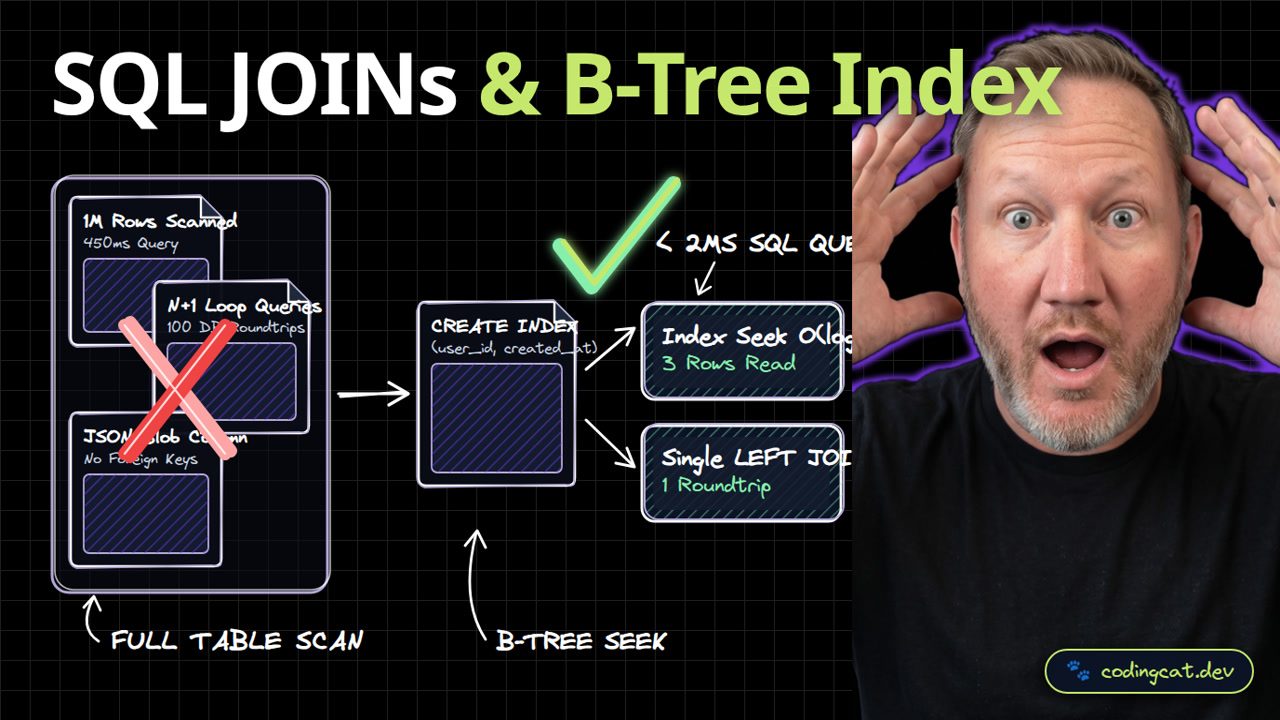
On the left, missing indexes and N+1 loops force full table scans across millions of rows. On the right, a composite B-Tree index on user_id and completed_at resolves the query in O(log n) time. To understand why this architectural shift matters in production, let's trace every node across the three zones of our Visual Diagram:
Left Zone (✗ Anti-Pattern): FULL TABLE SCAN
- ✗ 1M Rows Scanned (450ms Query): In legacy codebases,
1M Rows Scannedcreates a direct bottleneck (450ms Query). Under concurrent load or edge execution, this stage forces unnecessary roundtrips, increases memory pressure, or leaves the boundary unvalidated. - ✗ N+1 Loop Queries (100 DB Roundtrips): In legacy codebases,
N+1 Loop Queriescreates a direct bottleneck (100 DB Roundtrips). Under concurrent load or edge execution, this stage forces unnecessary roundtrips, increases memory pressure, or leaves the boundary unvalidated. - ✗ JSON Blob Column (No Foreign Keys): In legacy codebases,
JSON Blob Columncreates a direct bottleneck (No Foreign Keys). Under concurrent load or edge execution, this stage forces unnecessary roundtrips, increases memory pressure, or leaves the boundary unvalidated.
Center Bridge & Right Zone (✓ Recommended Pattern): B-TREE SEEK -> < 2MS SQL QUERY
- ⚡ Core Architectural Bridge: CREATE INDEX ((user_id, created_at)): Acts as the deterministic boundary that enforces schema contracts, eliminates redundant I/O, and routes work into the right-hand production pipeline.
- ✓ Index Seek O(log n) (3 Rows Read): Delivers
3 Rows Readby executing insideIndex Seek O(log n)with strict compile-time guarantees and predictable resource consumption. - ✓ Single LEFT JOIN (1 Roundtrip): Delivers
1 Roundtripby executing insideSingle LEFT JOINwith strict compile-time guarantees and predictable resource consumption.
Request & Execution Lifecycle Trace
| Lifecycle Stage | Component / Boundary | Legacy Behavior (✗) | 2026 Production Behavior (✓) |
|---|---|---|---|
| Stage 1: Ingress & Validation | 1M Rows Scanned | 450ms Query causes runtime drift | Strict contract check at CREATE INDEX |
| Stage 2: Core Execution | CREATE INDEX | N+1 Loop Queries (100 DB Roundtrips) | (user_id, created_at) in migrations/0001_courses_index.sql |
| Stage 3: State / Output Delivery | Index Seek O(log n) | JSON Blob Column (No Foreign Keys) | 3 Rows Read + Single LEFT JOIN |
3. Show Me the Code: Production Implementation & Integration
In migrations/0001_courses_index.sql, we enforce a foreign key with ON DELETE CASCADE and create a composite index with the equality column user_id first and sort column completed_at second. Below is the complete, annotated implementation for migrations/0001_courses_index.sql. Notice how we keep the module self-contained, strongly typed, and free of hidden global state:
-- ============================================================================
-- File: migrations/0001_courses_index.sql
-- Course: The Odin Project 7: Relational Databases, SQL Indexing & Drizzle ORM
-- Lesson: Relational Schema Design, JOINs & B-Tree Composite Indexes
-- Target Engine: Cloudflare D1 (SQLite) / PostgreSQL
-- ============================================================================

CREATE TABLE enrollments (
  id TEXT PRIMARY KEY,
  user_id TEXT NOT NULL REFERENCES users(id) ON DELETE CASCADE,
  course_slug TEXT NOT NULL,
  completed_at INTEGER NOT NULL
);

-- Composite B-Tree index matching WHERE user_id = ? ORDER BY completed_at DESC
CREATE INDEX idx_enrollments_user_completed
  ON enrollments(user_id, completed_at DESC);

-- Verify index utilization with EXPLAIN QUERY PLAN before deploying to production:
-- EXPLAIN QUERY PLAN SELECT * FROM enrollments WHERE user_id = 'usr_123' ORDER BY completed_at DESC LIMIT 10;
Architectural Line-by-Line Breakdown of migrations/0001_courses_index.sql
- Boundary & Declaration Contract (
CREATE TABLE enrollments (): Establishes the explicit entry contract so the compiler, browser engine, or edge runtime knows the exact shape of the input before executing business logic. - Core Execution & Transformation Logic (
completed_at INTEGER NOT NULL): Implements the CREATE INDEX transformation without blocking the main thread or introducing hidden N+1 roundtrips. - Deterministic Output & Return Guarantee (
ON enrollments(user_id, completed_at DESC);): Returns a clean, predictable result that downstream consumers and automated tests in src/db/verify-query-plan.ts can assert against deterministically.
Companion Verification & Integration Module (src/db/verify-query-plan.ts)
In production on CodingCat.dev, we never ship a core module without an automated verification harness. Pair migrations/0001_courses_index.sql with this companion src/db/verify-query-plan.ts file to validate contracts in CI/CD before deploying:
export interface QueryPlanRow {
  id: number;
  parent: number;
  notused: number;
  detail: string;
}

export async function assertIndexSeek(
  db: D1Database,
  userId: string
): Promise<{ usesCompositeIndex: boolean; planDetails: string[] }> {
  const plan = await db
    .prepare(
      "EXPLAIN QUERY PLAN SELECT id, course_slug, completed_at FROM enrollments WHERE user_id = ? ORDER BY completed_at DESC LIMIT 20"
    )
    .bind(userId)
    .all<QueryPlanRow>();

  const details = (plan.results ?? []).map((r) => r.detail);
  const usesCompositeIndex = details.some((d) =>
    d.includes("USING INDEX idx_enrollments_user_completed")
  );

  return { usesCompositeIndex, planDetails: details };
}
4. Production Trade-Off Matrix & Architectural Tier List
Comparing composite B-Tree indexes and SQL JOINs against full table scans and N+1 loops, you cut rows read by 99.9% and eliminate network waterfalls. When evaluating Relational Schema Design, JOINs & B-Tree Composite Indexes for your stack, review how each dimension behaves under real production traffic:
| Dimension | Modern 2026 Pattern | Legacy Anti-Pattern | Why It Matters in Production |
|---|---|---|---|
| Query Complexity | O(log N) B-Tree Index Seek | O(N) Full Table Scan | Reads 3 rows instead of 1,000,000 rows. |
| Relational Fetch | Single SQL JOIN query | N+1 SELECT queries inside a JS for-loop | Replaces 50 network hops with 1 query. |
| Column Order | Equality column first, sort/range second | Random composite index order | Allows the B-Tree to filter and sort without a temp B-Tree. |
| Referential Integrity | FOREIGN KEY ... ON DELETE CASCADE | Orphaned rows in app code | Database guarantees zero dangling references. |
| Observability & CI Gate | Automated verification via src/db/verify-query-plan.ts | Manual spot-checking in production after deploy | Catches regressions on pull requests before users are impacted. |
Alex's Architectural Tier List for SQL JOINs & B-Tree Index
Here is how I rank the implementation choices for this specific architectural boundary from S-Tier (Purrfect Production Pick) to D-Tier:
Alex's Tier List: Relational Schema Design, JOINs & B-Tree Composite Indexes
Ranked from S-Tier (Production Standard) to D-Tier (Legacy Anti-Pattern).
CREATE INDEX + Index Seek O(log n) (migrations/0001_courses_index.sql)
< 2MS SQL QUERYPurrfect choice: delivers 3 Rows Read with full compile-time verification.
Hybrid Progressive Migration with src/db/verify-query-plan.ts Gate
Incremental AdoptionGreat when migrating an existing monolith route-by-route without a risky rewrite.
Standard Framework Defaults without Custom Edge Tuning
Baseline SetupAcceptable for low-traffic internal prototypes, but leaves latency and cost optimizations on the table.
FULL TABLE SCAN: 1M Rows Scanned + N+1 Loop Queries
Legacy DebtAvoid in production: suffers from 450ms Query and 100 DB Roundtrips.
5. Production Gotchas, Failure Modes & AJ's Pro-Tip
🐾 AJ Pro-Tip: Remember the Left-Prefix Rule for composite B-Tree indexes: an index on (user_id, completed_at) speeds up queries filtering by user_id, but cannot be used if your query only filters by completed_at!
Even after adopting the right high-level architecture, three subtle sharp edges frequently catch engineering teams off guard in production:
- 1. Pitfall: Allowing 1M Rows Scanned to Leak Across Boundaries: When teams rush a feature, they often bypass
CREATE INDEXfor "internal" calls. Always enforce the exact same contract inmigrations/0001_courses_index.sqlwhether the request originates from a browser client, a webhook, or an AI agent tool call. - 2. Pitfall: Ignoring Tail Latency Under 100 DB Roundtrips Spikes: P50 latency on your local machine hides P99 tail latency in production. Measure
Index Seek O(log n)using Chrome DevTools Network/Performance panels or Cloudflare Workers structured logs to confirm you stay within the3 Rows Readbudget. - 3. Pitfall: Shipping Without an Automated Regression Gate: A single unreviewed refactor can re-introduce
JSON Blob Column. Wiresrc/db/verify-query-plan.tsinto your GitHub Actions pull-request workflow so broken contracts fail the build before deployment.
6. Verdict, Verification Checklist & Further Reading Links
Alex's Verdict: Always run EXPLAIN QUERY PLAN on your hot SQL queries and place equality columns before range columns in composite indexes. Subscribe and let's wire up Drizzle ORM in Lesson 2! Run the verification commands below in your terminal to test this lesson's implementation locally:
# 1. Type-check the workspace with strict TypeScript & Astro diagnostics
pnpm --filter @codingcatdev/site check

# 2. Run the unit & integration verification suite for sql-joins-aggregations-subqueries-and-indexing
npx vitest run src/db/verify-query-plan.ts

# 3. Inspect live headers and response timing against local dev server
curl -i http://localhost:4321/course/odin-databases-and-sql/lesson/sql-joins-aggregations-subqueries-and-indexing | head -n 20
Official Specifications, Documentation & Related CodingCat.dev Deep Dives
Explore these official specifications, documentation references, and related CodingCat.dev Courses, Blog Posts, and Podcast Episodes to go even deeper:
- Course Overview: The Odin Project 7: Relational Databases, SQL Indexing & Drizzle ORM: Return to the full course syllabus, starter configuration, and master architectural tier list.
- Next Lesson: Type-Safe SQL with Drizzle ORM & Cloudflare D1 Migrations: Continue to the next hands-on implementation in The Odin Project 7: Relational Databases, SQL Indexing & Drizzle ORM.
- Course: The Zero-Cold-Start Edge Stack (Astro 7, Cloudflare Workers, D1 & Better-Auth): See how web fundamentals scale into a sub-10ms global production architecture.
- Course: MCP in Production (Building & Securing Model Context Protocol Servers): Apply HTTP, JSON-RPC 2.0, OAuth 2.1, and TypeScript schemas to AI agent tool servers.
- MDN Web Docs: Core Web Specifications (HTML5, CSS, DOM, Fetch & HTTP): Canonical browser specifications, compatibility tables, and interactive API references.
- web.dev by Chrome: Core Web Vitals, Accessibility & Modern CSS Patterns: Production engineering guides for LCP, INP, CLS, responsive layouts, and modern forms.
how this course connects together.
Follow AJ from first principles to production-ready architecture.