

Stop Paying for Cloud LLMs: How Edge AI Actually Works
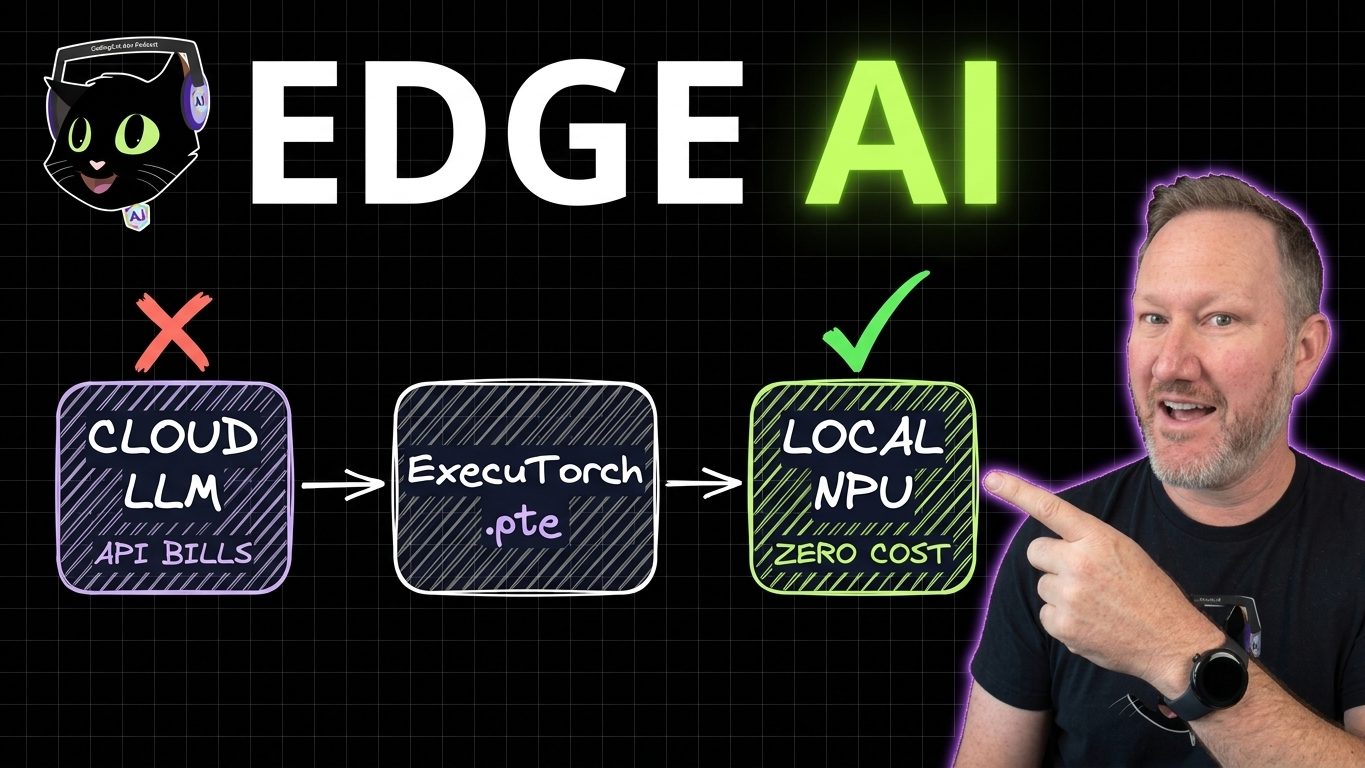


Everyone is burning API credits on massive frontier LLMs for tasks a 2B or 4B parameter model can run locally on a phone, laptop NPU, or local GPU. In this CodingCat.dev Podcast Episode, Alex Patterson sits down with Shivay Lamba (Qualcomm, formerly Couchbase) to break down how Edge AI actually ships to production: from WebAssembly and Cloudflare Workers vs. hardware NPUs to PyTorch ExecuTorch, Google LiteRT, hardware delegates (XNNPACK and Vulkan), quantization trade-offs (PTQ vs. QAT), and a live visual walkthrough of an LLM inference graph.
What You Will Learn in This Episode
- Cloud Frontier LLMs (vLLM / SGLang) vs. On-Device Edge Runtimes (PyTorch ExecuTorch .pte, Google LiteRT, ONNX Runtime): when to run models in the datacenter vs. locally.
- Hardware Delegates Explained: how XNNPACK (CPU), Vulkan (GPU), and Qualcomm QNN (NPU) translate model math onto local silicon without requiring low-level device code.
- Inside an LLM Inference Request: live visual walkthrough of tokenization, prefill, KV cache matrices, RMS normalization, and self-attention.
- Quantization Trade-Offs (TorchAO): balancing accuracy and speed across FP32, W8A16 mixed precision, W8A8, INT4, 1-bit quantization, PTQ, and QAT.
- Practical Local GPU Workflows (RTX 5090 / Mac Studio): using local 4B to 12B models for LLM-as-a-Judge evals, offline code explanation, and NPU Whisper transcription.
Episode Chapters (54:54)
- 00:00 Stop Burning Cash on Frontier LLMs (Intro)
- 00:36 From WebAssembly & Couchbase Lite to Edge AI at Qualcomm
- 02:37 Why Developers Are Moving Off Cloud Frontier LLMs
- 03:29 The 3 Tiers of On-Device AI (Racks, DGX Spark / Mac Studio, Phones)
- 06:22 Cloudflare Edge Workers (Wasm) vs. On-Device Hardware Edge
- 08:41 Real-World Edge AI: Offline Medical Agents & XR Voice Pipelines
- 12:58 Hybrid Inference: Router Models & State Machines
- 15:06 CUDA Lock-In, NPU Fragmentation & Running GGUF Models on Hardware
- 19:46 vLLM vs. PyTorch ExecuTorch, Google LiteRT & ONNX Runtime
- 22:51 CPU, GPU & NPU Hardware Delegates Explained (XNNPACK & Vulkan)
- 24:18 LangChain Agent Graphs vs. Static AI Model Graphs
- 28:21 Live Walkthrough: PyTorch torch.export & Edge IR Model Graphs
- 30:15 Live Demo: Inside an LLM Inference Request (Tokens, Prefill & KV Cache)
- 32:12 Quantization Explained: FP32 to INT8, 4-Bit, 1-Bit & TorchAO
- 36:34 Post-Training Quantization (PTQ) vs. Quantization-Aware Training (QAT)
- 37:38 India AI Ecosystem: Sarvam, 1,369 Mother Tongues & Offline IoT
- 45:45 What Is Next for Edge AI: Context Limits, Pruning & 1-Bit Models
- 50:19 What Should You Actually Run on an RTX 5090 Locally?
✏️ Episode Summary
webassembly wasm edge ai AutoDirector2: 🔔 Subscribe for weekly AI, MCP & Web Architecture deep dives: https://www.youtube.com/@codingcatdev?sub_confirmation=1 Everyone is burning API credits on massive frontier LLMs for tasks a 2B or 4B parameter model can run locally on a phone, laptop NPU, or local GPU. In this CodingCat.dev Podcast E
how this episode connects together.
Follow AJ through the pipeline topology from input contract to production output.