Sanity Content Operating System: Live Content API, Media Library & Functions
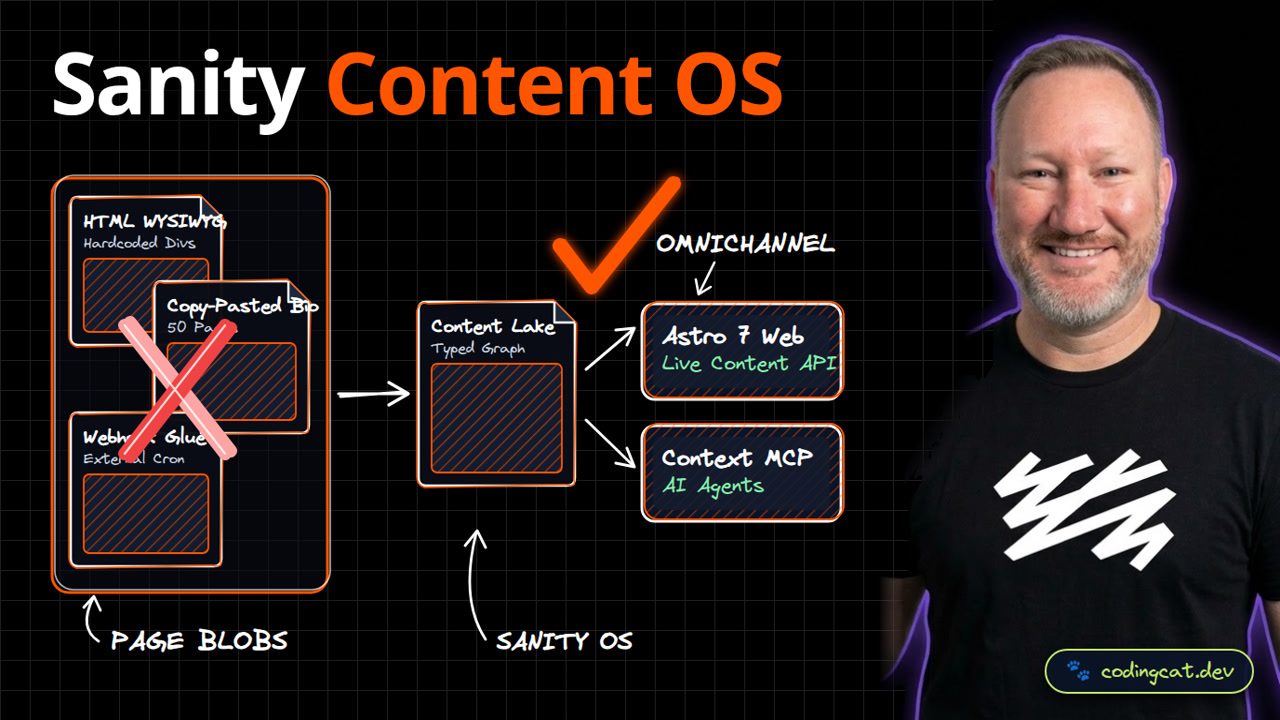
1. Production Architecture Problem & Why We Built This Course
Master the 2026 Sanity Content Operating System: structured schemas, TypeGen + stegaClean visual editing, Organization Media Library, Sanity App SDK, and event-driven Sanity Functions with Blueprints. In production engineering teams, the gap between a quick weekend demo and a resilient, multi-tenant system comes down to three architectural boundaries: cold-start latency, compile-time contract validation, and predictable operational cost. Throughout Sanity Content Operating System: Live Content API, Media Library & Functions, we strip away marketing buzzwords and build the exact TypeScript, edge compute, and structured data patterns that power CodingCat.dev in production.
Every lesson in this course pairs a dark-mode Architecture Diagram (contrasting the legacy anti-pattern on the left against the recommended 2026 production pattern on the right) with copy-pasteable TypeScript modules, automated verification checks, and an explicit Trade-Off Matrix. Whether you are reading the official Sanity Content Operating System Official Documentation or pairing this course with our deep dive on Blog Post: Sanity Knowledge Bases & Structured Agent Context, you can apply every pattern directly to your own repository today.
🐾 AJ's Course Architecture Rule: Never adopt a tool just because it trended on social media. Measure its cold start in milliseconds, verify its TypeScript schema boundary at compile time, and check what happens to your cloud bill when traffic spikes 100x.
2. Lesson-by-Lesson Architectural Walkthrough (5 Lessons)
Work through the lessons in sequence to build the complete system from first principles, or jump directly to the specific architectural boundary you are solving right now:
- Lesson 1: From Headless CMS to Content Operating System (Mental Model): Replaces the
PAGE BLOBS (HTML WYSIWYG, Copy-Pasted Bio, Webhook Glue)anti-pattern withContent Lake -> Astro 7 Web + Context MCPinsideapps/sanity/schemaTypes/courseType.ts. Storing raw HTML page blobs in a traditional CMS works until you need to feed that same content to an Astro web app, a mobile view, and an AI agent. Let's look at the Sanity Content Operating System mental model. - Lesson 2: Type-Safe GROQ & Visual Editing (and the stegaClean Gotcha): Replaces the
STEGA BUGS (Hidden Chars, Broken href, Failed === )anti-pattern withstegaClean() -> Click-to-Edit + Safe Attrsinsidesrc/lib/sanity.ts. Have you ever turned on Sanity Visual Editing and suddenly your string equality checks failed and your links threw 404s? That is the stegaClean gotcha. Let's fix it and set up type-safe GROQ. - Lesson 3: Organization Media Library: Custom Aspects, Folders & CDN Delivery: Replaces the
SILOED ASSETS (Dataset Silo, Missing Alt, Raw 8MB PNG)anti-pattern withMedia Library -> auto=format + Hotspot Cropinsidesrc/lib/sanity-images.ts. Re-uploading the same guest headshot and diagram across five different datasets wastes storage and loses your alt text every time. Let's look at the Sanity Organization Media Library and CDN pipeline. - Lesson 4: Building Custom Internal Tools with the Sanity App SDK: Replaces the
GENERIC FORMS (50 Open Tabs, Slow Bulk Ops, Custom Auth)anti-pattern with@sanity/sdk-react -> useDocuments() + useEditDocument()insideapps/ops/src/CourseDashboard.tsx. Sometimes your editorial or sponsorship team needs a focused kanban board or bulk release dashboard instead of a fifty-field form. Here is how to build custom internal apps in minutes with the Sanity App SDK. - Lesson 5: Event-Driven Sanity Functions & Blueprints: Replaces the
WEBHOOK SPAGHETTI (External Lambda, Secret Drift, Infinite Loop)anti-pattern withsanity.blueprint.ts -> onPublish Event + Auto Syndicateinsidesanity.blueprint.ts. Maintaining a separate AWS Lambda repo just to catch a CMS webhook and syndicate a post is pure infrastructure overhead. Let's replace external webhooks with native Sanity Functions and Blueprints.
3. Alex's 2026 Ecosystem & Architectural Tier List
Before writing a single line of configuration, you need to know how the available platforms and patterns stack up in real production environments. Here is how I rank the ecosystem from S-Tier (our default production choice on CodingCat.dev) down to D-Tier anti-patterns to avoid:
Alex's Content Operating System & Headless CMS Tier List (2026)
Evaluating content platforms on schema type-safety, real-time delivery, serverless compute integration, and AI agent readiness.
Sanity Content Operating System (Content Lake + Functions + App SDK + Context MCP) ↗
Programmable Content OSCombines a real-time normalized document graph, GROQ TypeGen, Organization Media Library, native event-driven Functions, and ahead-of-time Context MCP for AI agents.
Astro Content Collections + Git MDX ↗
Developer-Only Repo ContentFast, Zod-validated local Markdown/MDX files inside git, ideal for solo developer sites that do not require multi-editor collaboration, DAM, or live cross-project queries.
Legacy Form-Based Headless CMS + External AWS Lambda Webhooks
First-Gen Headless CMSForces teams to maintain separate serverless repos for every webhook, lacks native multi-dataset React SDKs, and charges steep enterprise upgrades for basic roles.
Monolithic WYSIWYG HTML Blob CMS
Page-Centric Legacy CMSMixes layout classes (`<div class='col-md-6'>`) directly into database text columns, making omnichannel reuse and structured AI retrieval nearly impossible.
4. Production Starter Configuration & Local Setup
To follow along with the code examples in Sanity Content Operating System: Live Content API, Media Library & Functions, start with this baseline sanity.blueprint.ts configuration. It enables strict TypeScript verification, observability tracing, and local development bindings that match production 1-to-1:
import { defineBlueprint, defineDocumentFunction } from "@sanity/blueprints";

export default defineBlueprint({
  resources: [
    defineDocumentFunction({
      name: "on-course-publish-sync",
      event: {
        on: ["publish"],
        filter: "_type in ['course', 'lesson', 'post', 'podcast']",
        projection: "{ _id, _type, title, 'slug': slug.current, lastUpdated }",
      },
    }),
  ],
});
5. Course-Wide Production Trade-Off Matrix
Every architectural decision involves trade-offs. Use this reference table during design reviews with your team to justify why we choose edge-native TypeScript, explicit schema validation, and deterministic workflows over legacy alternatives:
| Architectural Dimension | 2026 CodingCat.dev Course Pattern | Legacy Industry Default | Production Impact at Scale |
|---|---|---|---|
| Compute & Cold Starts | V8 Isolates / Native Browser Compositor (< 5ms) | Heavy Container VMs / Main-Thread JS Bloat (500ms+) | Eliminates tail-latency spikes on every request and interaction. |
| Contract & Type Safety | End-to-End TypeScript + Zod / GROQ TypeGen | Untyped JSON payloads & manual interface drift | Catches breaking schema changes in CI before deployment. |
| State & Database Topology | Cloudflare D1 Batch / Durable SQLite / Sanity Content Lake | Exhausted TCP pools & unindexed N+1 loops | Predictable sub-10ms reads with zero connection pool errors. |
| Security & Multi-Tenancy | OAuth 2.1 PKCE + Better-Auth Scoped Sessions | Shared static API keys & unescaped DOM strings | Zero-trust tenant isolation and $0 per-MAU SaaS tax. |
| AI & Agent Readiness | Streamable HTTP MCP + WebMCP + RFC 9727 + Daily Spend Caps | 20k-token headless DOM scraping & uncapped retry loops | Cuts token spend by 95%+ while preventing runaway bills. |
6. Official Specifications, Docs & Related CodingCat.dev Deep Dives
Bookmark these official specifications and related CodingCat.dev Courses, Blog Posts, and Podcast Episodes as you work through the lessons:
- Blog Post: Sanity Knowledge Bases & Structured Agent Context: How Sanity compiles structured content into deterministic knowledge bases for MCP agents.
- Blog Post: The Five Layers of Agentic Context: Why human-governed canonical schemas in Sanity outperform unverified document dumps.
- Course Lesson: Connecting MCP to Verified Knowledge Bases (Sanity Context): Wire up initial_context and knowledge_search over Streamable HTTP MCP.
- Course: The Zero-Cold-Start Edge Stack: Render Sanity Portable Text at the edge with Astro 7 Server Islands.
- Sanity Content Operating System Official Documentation: Complete reference for Content Lake, GROQ, TypeGen, Live Content API, and Studio v4.
- Sanity TypeGen & defineQuery End-to-End TypeScript Guide: Generating compile-time TypeScript types directly from your schema and GROQ queries.
- Sanity Visual Editing & stegaClean(@sanity/client/stega) Reference: How zero-width steganography powers click-to-edit overlays and where to strip it with stegaClean.
- Sanity Functions, Blueprints & App SDK (@sanity/sdk-react) Docs: Declarative sanity.blueprint.ts infrastructure and custom real-time React operational apps.
Ready to write code? Jump straight into Lesson 1: From Headless CMS to Content Operating System (Mental Model) →
course lessons.
Core Architecture & Production Implementation
- 1.1From Headless CMS to Content Operating System (Mental Model)
Storing raw HTML page blobs in a traditional CMS works until you need to feed that same content to an Astro web app, a mobile view, and an AI agent. Let's look at the Sanity Content Operating System mental model.
▶ Video + LessonStart Lesson → - 1.2Type-Safe GROQ & Visual Editing (and the stegaClean Gotcha)
Have you ever turned on Sanity Visual Editing and suddenly your string equality checks failed and your links threw 404s? That is the stegaClean gotcha. Let's fix it and set up type-safe GROQ.
▶ Video + LessonStart Lesson → - 1.3Organization Media Library: Custom Aspects, Folders & CDN Delivery
Re-uploading the same guest headshot and diagram across five different datasets wastes storage and loses your alt text every time. Let's look at the Sanity Organization Media Library and CDN pipeline.
▶ Video + LessonStart Lesson → - 1.4Building Custom Internal Tools with the Sanity App SDK
Sometimes your editorial or sponsorship team needs a focused kanban board or bulk release dashboard instead of a fifty-field form. Here is how to build custom internal apps in minutes with the Sanity App SDK.
▶ Video + LessonStart Lesson → - 1.5Event-Driven Sanity Functions & Blueprints
Maintaining a separate AWS Lambda repo just to catch a CMS webhook and syndicate a post is pure infrastructure overhead. Let's replace external webhooks with native Sanity Functions and Blueprints.
▶ Video + LessonStart Lesson →
how this course connects together.
Follow AJ from first principles to production-ready architecture.