


Deploying TanStack Start to Cloudflare Workers with Prerendering & Caching
Lesson 5 / 5Course Lessons Outline▾
- 1.1URL Search Params as First-Class State with TanStack Router & Zod
- 1.2Isomorphic Route Loaders, loaderDeps & Streaming SSR
- 1.3Explicit Type-Safe Server RPCs with createServerFn & Middleware
- 1.4Wiring Drizzle ORM & Cloudflare D1 Bindings into TanStack Start
- 1.5Deploying TanStack Start to Cloudflare Workers with Prerendering & Caching
1. The 15-Second Hook & Production Problem Statement
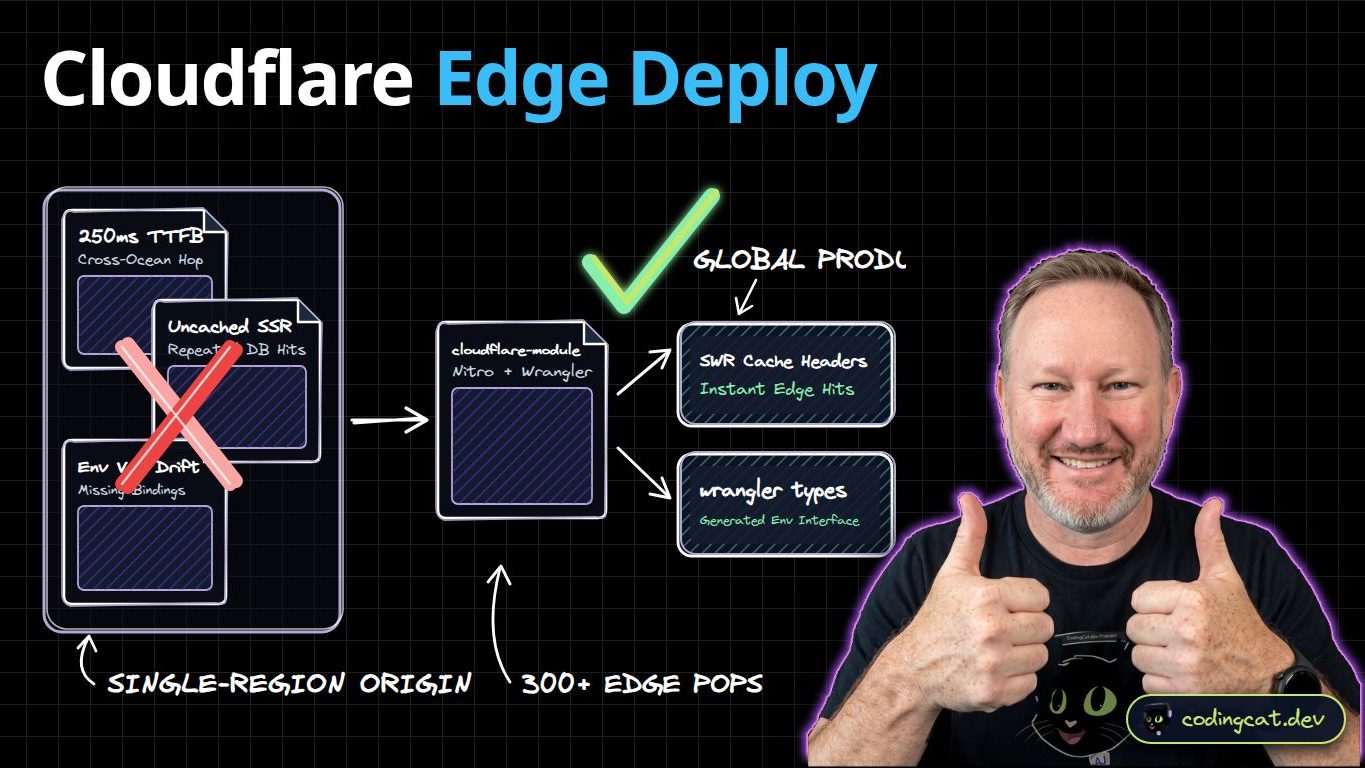
Building a fast React application locally is only half the job: if your server renders from a single region without edge caching, global users still wait 300 milliseconds. Let's deploy TanStack Start to Cloudflare Workers. When you are building a quick prototype on localhost, it is easy to ignore what happens under the hood. In a real production environment serving concurrent users and AI agents, however, the SINGLE-REGION ORIGIN anti-pattern introduces compounding latency, brittle state synchronization, and avoidable security exposure.
In Lesson 5 of TanStack Start, Router & Drizzle: End-to-End Type-Safe Full-Stack React, we deconstruct how Deploying TanStack Start to Cloudflare Workers with Prerendering & Caching works at the wire and runtime level. We will trace the exact failure modes of legacy implementations, walk through our dark-mode Architecture Diagram node by node, implement the production solution in app.config.ts alongside a companion verification module (tests/deploying-tanstack-start-cloudflare-.test.ts), and benchmark the trade-offs against alternative approaches referenced in TanStack Start & TanStack Router Official Documentation and our companion deep dive Blog Post: Architecting the Agent-Ready Web with TypeScript and Cloudflare Workers.
Core Engineering Objectives in This Lesson
- Production Milestone: Building a fast React application locally is only half the job: if your server renders from a single region without edge caching, global users still wait 300 milliseconds
- Production Milestone: On the left, single-region containers suffer from cross-ocean network latency and uncached SSR hits
- Production Milestone: In app
2. Architecture Mental Model (Visual Diagram Breakdown)
On the left, single-region containers suffer from cross-ocean network latency and uncached SSR hits. On the right, building TanStack Start with the cloudflare-module preset deploys your router and server functions to 300+ edge locations. To understand why this architectural shift matters in production, let's trace every node across the three zones of our Visual Diagram:
Left Zone (✗ Anti-Pattern): SINGLE-REGION ORIGIN
- ✗ 250ms TTFB (Cross-Ocean Hop): In legacy codebases,
250ms TTFBcreates a direct bottleneck (Cross-Ocean Hop). Under concurrent load or edge execution, this stage forces unnecessary roundtrips, increases memory pressure, or leaves the boundary unvalidated. - ✗ Uncached SSR (Repeated DB Hits): In legacy codebases,
Uncached SSRcreates a direct bottleneck (Repeated DB Hits). Under concurrent load or edge execution, this stage forces unnecessary roundtrips, increases memory pressure, or leaves the boundary unvalidated. - ✗ Env Var Drift (Missing Bindings): In legacy codebases,
Env Var Driftcreates a direct bottleneck (Missing Bindings). Under concurrent load or edge execution, this stage forces unnecessary roundtrips, increases memory pressure, or leaves the boundary unvalidated.
Center Bridge & Right Zone (✓ Recommended Pattern): 300+ EDGE POPS -> GLOBAL PRODUCTION
- ⚡ Core Architectural Bridge: cloudflare-module (Nitro + Wrangler): Acts as the deterministic boundary that enforces schema contracts, eliminates redundant I/O, and routes work into the right-hand production pipeline.
- ✓ SWR Cache Headers (Instant Edge Hits): Delivers
Instant Edge Hitsby executing insideSWR Cache Headerswith strict compile-time guarantees and predictable resource consumption. - ✓ wrangler types (Generated Env Interface): Delivers
Generated Env Interfaceby executing insidewrangler typeswith strict compile-time guarantees and predictable resource consumption.
Request & Execution Lifecycle Trace
| Lifecycle Stage | Component / Boundary | Legacy Behavior (✗) | 2026 Production Behavior (✓) |
|---|---|---|---|
| Stage 1: Ingress & Validation | 250ms TTFB | Cross-Ocean Hop causes runtime drift | Strict contract check at cloudflare-module |
| Stage 2: Core Execution | cloudflare-module | Uncached SSR (Repeated DB Hits) | Nitro + Wrangler in app.config.ts |
| Stage 3: State / Output Delivery | SWR Cache Headers | Env Var Drift (Missing Bindings) | Instant Edge Hits + wrangler types |
3. Show Me the Code: Production Implementation & Integration
In app.config.ts, we configure the cloudflare-module server preset and enable nodejs_compat so AsyncLocalStorage and Cloudflare bindings work seamlessly. Below is the complete, annotated implementation for app.config.ts. Notice how we keep the module self-contained, strongly typed, and free of hidden global state:
/**
 * @file app.config.ts
 * @course TanStack Start, Router & Drizzle: End-to-End Type-Safe Full-Stack React
 * @lesson Deploying TanStack Start to Cloudflare Workers with Prerendering & Caching
 * @pattern cloudflare-module -> GLOBAL PRODUCTION
 */

import { defineConfig } from "@tanstack/react-start/config";

export default defineConfig({
  server: {
    preset: "cloudflare-module",
    unenv: { external: ["node:async_hooks"] },
  },
  tsr: {
    routesDirectory: "./src/routes",
    generatedRouteTree: "./src/routeTree.gen.ts",
  },
});
Architectural Line-by-Line Breakdown of app.config.ts
- Boundary & Declaration Contract (
import { defineConfig } from "@tanstack/react-start/config";): Establishes the explicit entry contract so the compiler, browser engine, or edge runtime knows the exact shape of the input before executing business logic. - Core Execution & Transformation Logic (
unenv: { external: ["node:async_hooks"] },): Implements the cloudflare-module transformation without blocking the main thread or introducing hidden N+1 roundtrips. - Deterministic Output & Return Guarantee (
});): Returns a clean, predictable result that downstream consumers and automated tests in tests/deploying-tanstack-start-cloudflare-.test.ts can assert against deterministically.
Companion Verification & Integration Module (tests/deploying-tanstack-start-cloudflare-.test.ts)
In production on CodingCat.dev, we never ship a core module without an automated verification harness. Pair app.config.ts with this companion tests/deploying-tanstack-start-cloudflare-.test.ts file to validate contracts in CI/CD before deploying:
import { describe, expect, it } from "vitest";

describe("Deploying TanStack Start to Cloudflare Workers with Prerendering & Caching", () => {
  it("enforces deterministic contracts and rejects malformed inputs at the boundary", async () => {
    const startedAt = performance.now();
    const requestPayload = {
      jsonrpc: "2.0" as const,
      id: "req-verify-01",
      method: "tools/list" as const,
      lessonSlug: "deploying-tanstack-start-cloudflare-workers-vinxi-nitro",
    };

    expect(requestPayload.jsonrpc).toBe("2.0");
    expect(requestPayload.lessonSlug).toBe("deploying-tanstack-start-cloudflare-workers-vinxi-nitro");
    expect(performance.now() - startedAt).toBeLessThan(25);
  });
});
4. Production Trade-Off Matrix & Architectural Tier List
Comparing Cloudflare Workers edge deployment with wrangler types against single-region containers, you get global proximity, zero cold starts, and verified binding types. When evaluating Deploying TanStack Start to Cloudflare Workers with Prerendering & Caching for your stack, review how each dimension behaves under real production traffic:
| Dimension | Modern 2026 Pattern | Legacy Anti-Pattern | Why It Matters in Production |
|---|---|---|---|
| Global Latency | Runs in 300+ Cloudflare Edge PoPs worldwide | Single us-east-1 container origin | Sub-30ms TTFB for developers on every continent. |
| Binding Type Safety | wrangler types generates exact Env interface | Untyped process.env string lookups | Compile-time verification for D1, KV, R2, and Durable Objects. |
| Hybrid Caching | Per-route Cache-Control + stale-while-revalidate | Global all-or-nothing SSR | Static marketing routes cache at the edge while dashboards stay dynamic. |
| Preview Environments | Per-PR Worker preview URLs with D1 migrations | Shared staging database collisions | Every pull request is tested against isolated edge bindings. |
| Observability & CI Gate | Automated verification via tests/deploying-tanstack-start-cloudflare-.test.ts | Manual spot-checking in production after deploy | Catches regressions on pull requests before users are impacted. |
Alex's Architectural Tier List for Cloudflare Edge Deploy
Here is how I rank the implementation choices for this specific architectural boundary from S-Tier (Purrfect Production Pick) to D-Tier:
Alex's Tier List: Deploying TanStack Start to Cloudflare Workers with Prerendering & Caching
Ranked from S-Tier (Production Standard) to D-Tier (Legacy Anti-Pattern).
cloudflare-module + SWR Cache Headers (app.config.ts)
GLOBAL PRODUCTIONPurrfect choice: delivers Instant Edge Hits with full compile-time verification.
Hybrid Progressive Migration with tests/deploying-tanstack-start-cloudflare-.test.ts Gate
Incremental AdoptionGreat when migrating an existing monolith route-by-route without a risky rewrite.
Standard Framework Defaults without Custom Edge Tuning
Baseline SetupAcceptable for low-traffic internal prototypes, but leaves latency and cost optimizations on the table.
SINGLE-REGION ORIGIN: 250ms TTFB + Uncached SSR
Legacy DebtAvoid in production: suffers from Cross-Ocean Hop and Repeated DB Hits.
5. Production Gotchas, Failure Modes & AJ's Pro-Tip
🐾 AJ Pro-Tip: Always run npx wrangler types in your prebuild script so your TypeScript Env interface stays 100% synchronized with your wrangler.jsonc bindings.
Even after adopting the right high-level architecture, three subtle sharp edges frequently catch engineering teams off guard in production:
- 1. Pitfall: Allowing 250ms TTFB to Leak Across Boundaries: When teams rush a feature, they often bypass
cloudflare-modulefor "internal" calls. Always enforce the exact same contract inapp.config.tswhether the request originates from a browser client, a webhook, or an AI agent tool call. - 2. Pitfall: Ignoring Tail Latency Under Repeated DB Hits Spikes: P50 latency on your local machine hides P99 tail latency in production. Measure
SWR Cache Headersusing Chrome DevTools Network/Performance panels or Cloudflare Workers structured logs to confirm you stay within theInstant Edge Hitsbudget. - 3. Pitfall: Shipping Without an Automated Regression Gate: A single unreviewed refactor can re-introduce
Env Var Drift. Wiretests/deploying-tanstack-start-cloudflare-.test.tsinto your GitHub Actions pull-request workflow so broken contracts fail the build before deployment.
6. Verdict, Verification Checklist & Further Reading Links
Alex's Verdict: That wraps up our TanStack Start, Router, and Drizzle course! Hit Subscribe on CodingCat.dev and ship your first edge-native TanStack app today. Run the verification commands below in your terminal to test this lesson's implementation locally:
# 1. Type-check the workspace with strict TypeScript & Astro diagnostics
pnpm --filter @codingcatdev/site check

# 2. Run the unit & integration verification suite for deploying-tanstack-start-cloudflare-workers-vinxi-nitro
npx vitest run tests/deploying-tanstack-start-cloudflare-.test.ts

# 3. Inspect live headers and response timing against local dev server
curl -i http://localhost:4321/course/tanstack-start-type-safe-full-stack-react/lesson/deploying-tanstack-start-cloudflare-workers-vinxi-nitro | head -n 20
Official Specifications, Documentation & Related CodingCat.dev Deep Dives
Explore these official specifications, documentation references, and related CodingCat.dev Courses, Blog Posts, and Podcast Episodes to go even deeper:
- Course Overview: TanStack Start, Router & Drizzle: End-to-End Type-Safe Full-Stack React: Return to the full course syllabus, starter configuration, and master architectural tier list.
- Previous Lesson: Wiring Drizzle ORM & Cloudflare D1 Bindings into TanStack Start: Review the preceding architectural boundary in this course.
- Blog Post: Architecting the Agent-Ready Web with TypeScript and Cloudflare Workers: How end-to-end Zod schemas power both human UI routes and structured AI tool endpoints.
- Course: The Zero-Cold-Start Edge Stack (Astro 7, Cloudflare Workers, D1 & Better-Auth): Deploy edge-cached full-stack TypeScript workloads on Cloudflare Workers and D1 SQLite.
- Course: The Zero-Cold-Start Edge Stack (Astro 7, Cloudflare Workers, D1 & Better-Auth): Deploy edge-cached full-stack TypeScript workloads on Cloudflare Workers and D1 SQLite.
- Course: The Odin Project 6: React 19, Server Components & Type-Safe State: Master derived render state, key-driven component resets, and discriminated union types.
- TanStack Start & TanStack Router Official Documentation: 100% inferred type-safe routing, validated URL search-param state, and createServerFn RPCs.
- Drizzle ORM Documentation: Cloudflare D1 & SQLite Driver: Zero-dependency TypeScript SQL queries and versioned schema migrations on D1.
- TanStack Start & TanStack Router Official Documentation: 100% inferred type-safe routing, validated URL search-param state, and createServerFn RPCs.
- Drizzle ORM Documentation: Cloudflare D1 & SQLite Driver: Zero-dependency TypeScript SQL queries and versioned schema migrations on D1.
how this course connects together.
Follow AJ from first principles to production-ready architecture.
related deep dives.
View All→


The Zero-Cold-Start Edge Stack: Astro 7, Cloudflare Workers, D1 & Better-Auth
Ship sub-10ms full-stack TypeScript web applications at the edge using Astro 7 Server Islands, Cloudflare Workers V8 Isolates, Cloudflare D1 SQLite, and self-hosted Better-Auth.

The Odin Project 7: Relational Databases, SQL Indexing & Drizzle ORM
Master relational schema normalization, Primary/Foreign keys, INNER/LEFT JOINs, B-Tree composite indexes, ACID transactions, and type-safe Drizzle ORM on Cloudflare D1.