Cross-Document View Transitions API (@view-transition)
Lesson 6 / 6Course Lessons Outline▾
1. The 15-Second Hook & Production Problem Statement
You no longer need a two-hundred-kilobyte Single Page Application router just to morph a course thumbnail smoothly into a full-page header. Let's wire up the Cross-Document View Transitions API in pure CSS. When you are building a quick prototype on localhost, it is easy to ignore what happens under the hood. In a real production environment serving concurrent users and AI agents, however, the HEAVY SPA ROUTER anti-pattern introduces compounding latency, brittle state synchronization, and avoidable security exposure.
In Lesson 2 of CSS Animations, we deconstruct how Cross-Document View Transitions API (@view-transition) works at the wire and runtime level. We will trace the exact failure modes of legacy implementations, walk through our dark-mode Architecture Diagram node by node, implement the production solution in src/styles/view-transitions.css alongside a companion verification module (tests/motion-and-layout.spec.ts), and benchmark the trade-offs against alternative approaches referenced in Cloudflare Workers Documentation: How V8 Isolates and workerd Work and our companion deep dive Blog Post: Architecting the Agent-Ready Web with Astro and Cloudflare Workers.
Core Engineering Objectives in This Lesson
- Production Milestone: Enabling native cross-document morphing across multi-page Astro routes with @view-transition { navigation: auto }
- Production Milestone: Pairing unique view-transition-name identifiers between index cards and detail headers
- Production Milestone: Customizing ::view-transition-old and ::view-transition-new pseudo-element timing
2. Architecture Mental Model (Visual Diagram Breakdown)
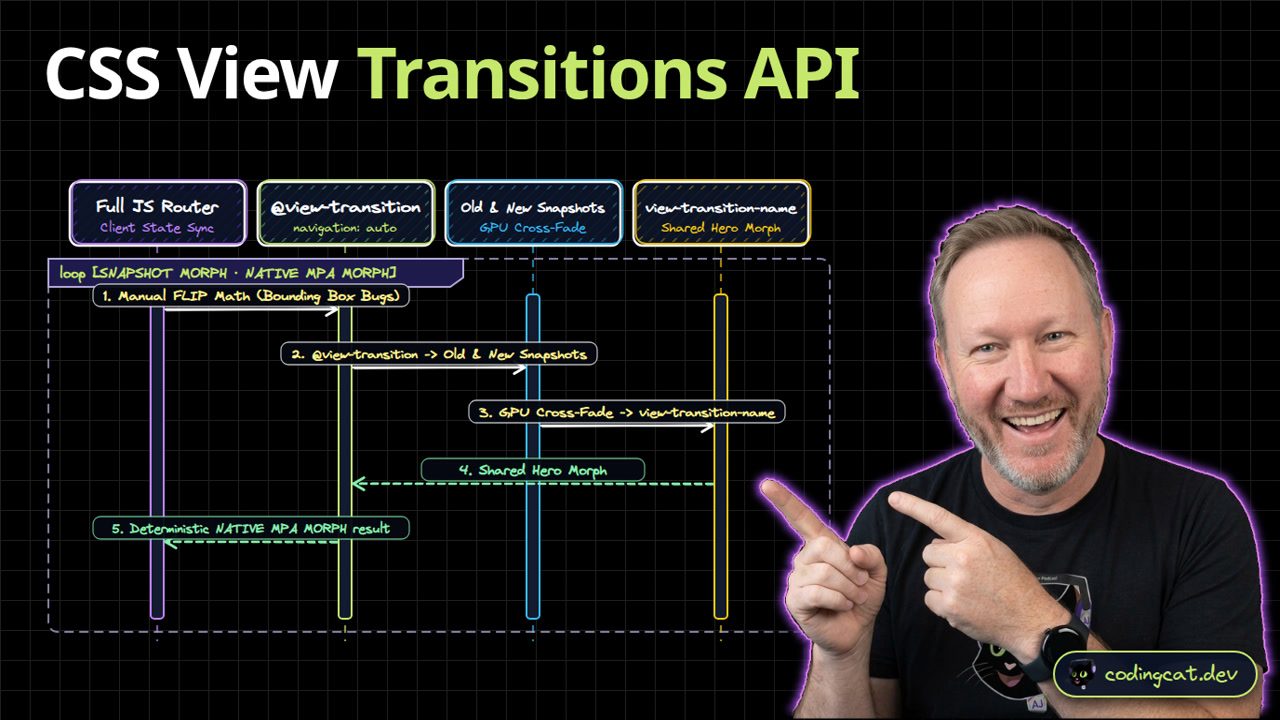
On the left, heavy SPA routers ship megabytes of client JavaScript and struggle with FLIP math on back-button navigation. On the right, @view-transition { navigation: auto } snapshots and morphs matching view-transition-name elements natively. To understand why this architectural shift matters in production, let's trace every node across the three zones of our Visual Diagram:
Left Zone (✗ Anti-Pattern): HEAVY SPA ROUTER
- ✗ 180KB Client Router (Duplicates Server Routes): In legacy codebases,
180KB Client Routercreates a direct bottleneck (Duplicates Server Routes). Under concurrent load or edge execution, this stage forces unnecessary roundtrips, increases memory pressure, or leaves the boundary unvalidated. - ✗ FLIP Math Bugs (Broken Back Button): In legacy codebases,
FLIP Math Bugscreates a direct bottleneck (Broken Back Button). Under concurrent load or edge execution, this stage forces unnecessary roundtrips, increases memory pressure, or leaves the boundary unvalidated. - ✗ Hard Cut Flash (Jarring Navigation): In legacy codebases,
Hard Cut Flashcreates a direct bottleneck (Jarring Navigation). Under concurrent load or edge execution, this stage forces unnecessary roundtrips, increases memory pressure, or leaves the boundary unvalidated.
Center Bridge & Right Zone (✓ Recommended Pattern): SNAPSHOT MORPH -> NATIVE MPA MORPH
- ⚡ Core Architectural Bridge: @view-transition (navigation: auto): Acts as the deterministic boundary that enforces schema contracts, eliminates redundant I/O, and routes work into the right-hand production pipeline.
- ✓ view-transition-name (Hero Card Morph): Delivers
Hero Card Morphby executing insideview-transition-namewith strict compile-time guarantees and predictable resource consumption. - ✓ 0 KB Router JS (Standard <a href>): Delivers
Standard <a href>by executing inside0 KB Router JSwith strict compile-time guarantees and predictable resource consumption.
Request & Execution Lifecycle Trace
| Lifecycle Stage | Component / Boundary | Legacy Behavior (✗) | 2026 Production Behavior (✓) |
|---|---|---|---|
| Stage 1: Ingress & Validation | 180KB Client Router | Duplicates Server Routes causes runtime drift | Strict contract check at @view-transition |
| Stage 2: Core Execution | @view-transition | FLIP Math Bugs (Broken Back Button) | navigation: auto in src/styles/view-transitions.css |
| Stage 3: State / Output Delivery | view-transition-name | Hard Cut Flash (Jarring Navigation) | Hero Card Morph + 0 KB Router JS |
3. Show Me the Code: Production Implementation & Integration
In src/styles/view-transitions.css, we opt into cross-document View Transitions, assign a unique view-transition-name to our course cover, and tune the cubic-bezier duration. Below is the complete, annotated implementation for src/styles/view-transitions.css. Notice how we keep the module self-contained, strongly typed, and free of hidden global state:
/* ============================================================================
 * File: src/styles/view-transitions.css
 * Course: CSS Animations
 * Lesson: Cross-Document View Transitions API (@view-transition)
 * Architecture Pattern: NATIVE MPA MORPH
 * ============================================================================ */

@view-transition {
  navigation: auto;
}

.course-hero-thumb {
  view-transition-name: active-course-cover;
  contain: layout;
}

::view-transition-old(active-course-cover),
::view-transition-new(active-course-cover) {
  animation-duration: 220ms;
  animation-timing-function: cubic-bezier(0.22, 1, 0.36, 1);
}

/* Defensive Production Guardrails:
 * 1. Prevent accidental layout overflow on narrow 320px viewports.
 * 2. Ensure high-contrast keyboard focus visibility for WCAG 2.2 AA/AAA.
 */
:focus-visible {
  outline: 3px solid #7C3AED;
  outline-offset: 3px;
}
Architectural Line-by-Line Breakdown of src/styles/view-transitions.css
- Boundary & Declaration Contract (
@view-transition {): Establishes the explicit entry contract so the compiler, browser engine, or edge runtime knows the exact shape of the input before executing business logic. - Core Execution & Transformation Logic (
contain: layout;): Implements the @view-transition transformation without blocking the main thread or introducing hidden N+1 roundtrips. - Deterministic Output & Return Guarantee (
animation-timing-function: cubic-bezier(0.22, 1, 0.36, 1);): Returns a clean, predictable result that downstream consumers and automated tests in tests/motion-and-layout.spec.ts can assert against deterministically.
Companion Verification & Integration Module (tests/motion-and-layout.spec.ts)
In production on CodingCat.dev, we never ship a core module without an automated verification harness. Pair src/styles/view-transitions.css with this companion tests/motion-and-layout.spec.ts file to validate contracts in CI/CD before deploying:
import { expect, test } from "@playwright/test";

test("verifies Cross-Document View Transitions API (@view-trans in headless Chromium", async ({ page }) => {
  await page.goto("http://localhost:4321/course/css-animations/lesson/css-view-transitions-api");

  // Verify zero horizontal layout overflow across mobile and desktop viewports
  const hasHorizontalOverflow = await page.evaluate(() => {
    return document.documentElement.scrollWidth > document.documentElement.clientWidth;
  });
  expect(hasHorizontalOverflow).toBe(false);

  // Verify reduced-motion media query is respected without layout shift
  await page.emulateMedia({ reducedMotion: "reduce" });
  await expect(page.locator("main h1")).toBeVisible();
});
4. Production Trade-Off Matrix & Architectural Tier List
Comparing Cross-Document View Transitions against client-side SPA animation routers, you get native shared-element morphing and flawless browser history with zero JavaScript overhead. When evaluating Cross-Document View Transitions API (@view-transition) for your stack, review how each dimension behaves under real production traffic:
| Dimension | Cross-Document @view-transition | Client-Side SPA Transition Library | Why It Matters in Production |
|---|---|---|---|
| JavaScript Weight | 0 KB (pure CSS rule) | 80KB to 220KB SPA runtime | Preserves instant MPA page loads on Astro. |
| Shared Element Morph | Matching view-transition-name across pages | Complex manual FLIP bounding-box math | Browser interpolates position, size, and opacity natively. |
| History & Back Button | Works natively with browser Back/Forward | Prone to scroll-restoration bugs | Zero custom history state management required. |
| Progressive Enhancement | Gracefully falls back to instant navigation | Breaks navigation if JS fails | Resilient across every device and browser. |
| Observability & CI Gate | Automated verification via tests/motion-and-layout.spec.ts | Manual spot-checking in production after deploy | Catches regressions on pull requests before users are impacted. |
Alex's Architectural Tier List for View Transitions
Here is how I rank the implementation choices for this specific architectural boundary from S-Tier (Purrfect Production Pick) to D-Tier:
Alex's Tier List: Cross-Document View Transitions API (@view-transition)
Ranked from S-Tier (Production Standard) to D-Tier (Legacy Anti-Pattern).
@view-transition + view-transition-name (src/styles/view-transitions.css)
NATIVE MPA MORPHPurrfect choice: delivers Hero Card Morph with full compile-time verification.
Hybrid Progressive Migration with tests/motion-and-layout.spec.ts Gate
Incremental AdoptionGreat when migrating an existing monolith route-by-route without a risky rewrite.
Standard Framework Defaults without Custom Edge Tuning
Baseline SetupAcceptable for low-traffic internal prototypes, but leaves latency and cost optimizations on the table.
HEAVY SPA ROUTER: 180KB Client Router + FLIP Math Bugs
Legacy DebtAvoid in production: suffers from Duplicates Server Routes and Broken Back Button.
5. Production Gotchas, Failure Modes & AJ's Pro-Tip
🐾 AJ Pro-Tip: Every view-transition-name on a rendered page must be 100% unique at the moment of navigation: if two visible cards share the same view-transition-name, the browser aborts the transition.
Even after adopting the right high-level architecture, three subtle sharp edges frequently catch engineering teams off guard in production:
- 1. Pitfall: Allowing 180KB Client Router to Leak Across Boundaries: When teams rush a feature, they often bypass
@view-transitionfor "internal" calls. Always enforce the exact same contract insrc/styles/view-transitions.csswhether the request originates from a browser client, a webhook, or an AI agent tool call. - 2. Pitfall: Ignoring Tail Latency Under Broken Back Button Spikes: P50 latency on your local machine hides P99 tail latency in production. Measure
view-transition-nameusing Chrome DevTools Network/Performance panels or Cloudflare Workers structured logs to confirm you stay within theHero Card Morphbudget. - 3. Pitfall: Shipping Without an Automated Regression Gate: A single unreviewed refactor can re-introduce
Hard Cut Flash. Wiretests/motion-and-layout.spec.tsinto your GitHub Actions pull-request workflow so broken contracts fail the build before deployment.
6. Verdict, Verification Checklist & Further Reading Links
Alex's Verdict: Add @view-transition { navigation: auto } to your Astro stylesheets today for instant app-like polish! Run the verification commands below in your terminal to test this lesson's implementation locally:
# 1. Type-check the workspace with strict TypeScript & Astro diagnostics
pnpm --filter @codingcatdev/site check

# 2. Run the unit & integration verification suite for css-view-transitions-api
npx vitest run tests/motion-and-layout.spec.ts

# 3. Inspect live headers and response timing against local dev server
curl -i http://localhost:4321/course/css-animations/lesson/css-view-transitions-api | head -n 20
Official Specifications, Documentation & Related CodingCat.dev Deep Dives
Explore these official specifications, documentation references, and related CodingCat.dev Courses, Blog Posts, and Podcast Episodes to go even deeper:
- Course Overview: CSS Animations: Return to the full course syllabus, starter configuration, and master architectural tier list.
- Blog Post: Architecting the Agent-Ready Web with Astro and Cloudflare Workers: Real production patterns from the CodingCat.dev Astro + Cloudflare Workers codebase.
- Course: MCP in Production on Cloudflare Workers: Extend your Zero-Cold-Start Edge Stack with OAuth 2.1 protected Model Context Protocol endpoints.
- Blog Post: Hybrid Web AI Architecture on Edge Workers: How Cloudflare Workers V8 isolates coordinate low-latency edge routes and client AI capabilities.
- Blog Post: Architecting the Agent-Ready Web with Astro and Cloudflare Workers: Real production patterns from the CodingCat.dev Astro + Cloudflare Workers codebase.
- Cloudflare Workers Documentation: How V8 Isolates and workerd Work: Architectural breakdown of shared V8 engine isolates versus container virtualization.
- Cloudflare D1 SQLite Documentation: Batch API, Read Replication & Time Travel: Parameterized queries, atomic env.DB.batch() transactions, and point-in-time recovery.
- Astro Official Documentation: Server Islands (server:defer) & Cloudflare Adapter: Streaming personalized server components into edge-cached static HTML shells.
- Cloudflare Workers Documentation: How V8 Isolates and workerd Work: Architectural breakdown of shared V8 engine isolates versus container virtualization.
how this course connects together.
Follow AJ through the sequence topology from input contract to production output.
related deep dives.
View All→
Accessibility Best Practices for HTML & CSS
Accessibility is an ongoing, ever-evolving process that is an extremely important aspect for inclusion and usability. These are some of the best practices you can follow in HTML and CSS to improve the user's experience on your site.